 Bad Boy Labs

An AI receptionist that sounds confident is not the same as one that is authorised to confirm something. That gap, between sounding sure and actually being sure, is where a small catering business got into trouble in November 2026. Their agent was telling callers their order was confirmed and giving collection times before anyone on the team had agreed to either. The business then had to ring customers back and walk it all out. That erodes trust faster than a missed call ever would.
The problem, in plain terms
A caller rings, asks whether you can do thirty portions of pulled pork for Saturday, and your AI agent says yes and gives them a midday collection slot. Nobody on your team has seen the request. You find out when the customer turns up, or when you happen to check the transcript. Now you’re either scrambling to honour a promise you didn’t make, or you’re ringing the customer to disappoint them.
This is not a rare edge case. It happens whenever an AI agent is given the job of handling enquiries but not given an explicit rule about what it is and isn’t allowed to commit to. The agent fills the silence with confidence, because that is what it is trained to do. It sounds helpful. It is actually writing cheques the business has to cash.
Work out what this costs you. How many inbound enquiries do you take in a week? Of those, how many involve something that needs checking, a date, a quantity, a price, availability? If the agent gets even one of those wrong per week and it takes thirty minutes of your time to sort out the fallout, that’s over twenty-five hours a year spent managing promises you never made. At your own hourly rate, that’s real money. And it only takes one badly handled customer to leave a review about it.
Three ways to fix it
Option one: put a human back on every call. If you or a member of staff answers every enquiry, there is no agent to over-promise. This is the safest option for accuracy. It is also why you were looking at an AI agent in the first place. If you have the capacity to answer every call reliably, you probably don’t need the agent. For most owners, this option is not realistic during a busy service, on a weekend, or when you’re on a job.
Option two: leave the agent as it is and hope it’s usually right. This is the actual failure mode. The agent will be right most of the time, which makes the problem invisible until it isn’t. You’ll find out about the exceptions when a customer is already annoyed. The cost is not just the individual fix; it’s the slow drip of your reputation for reliability.
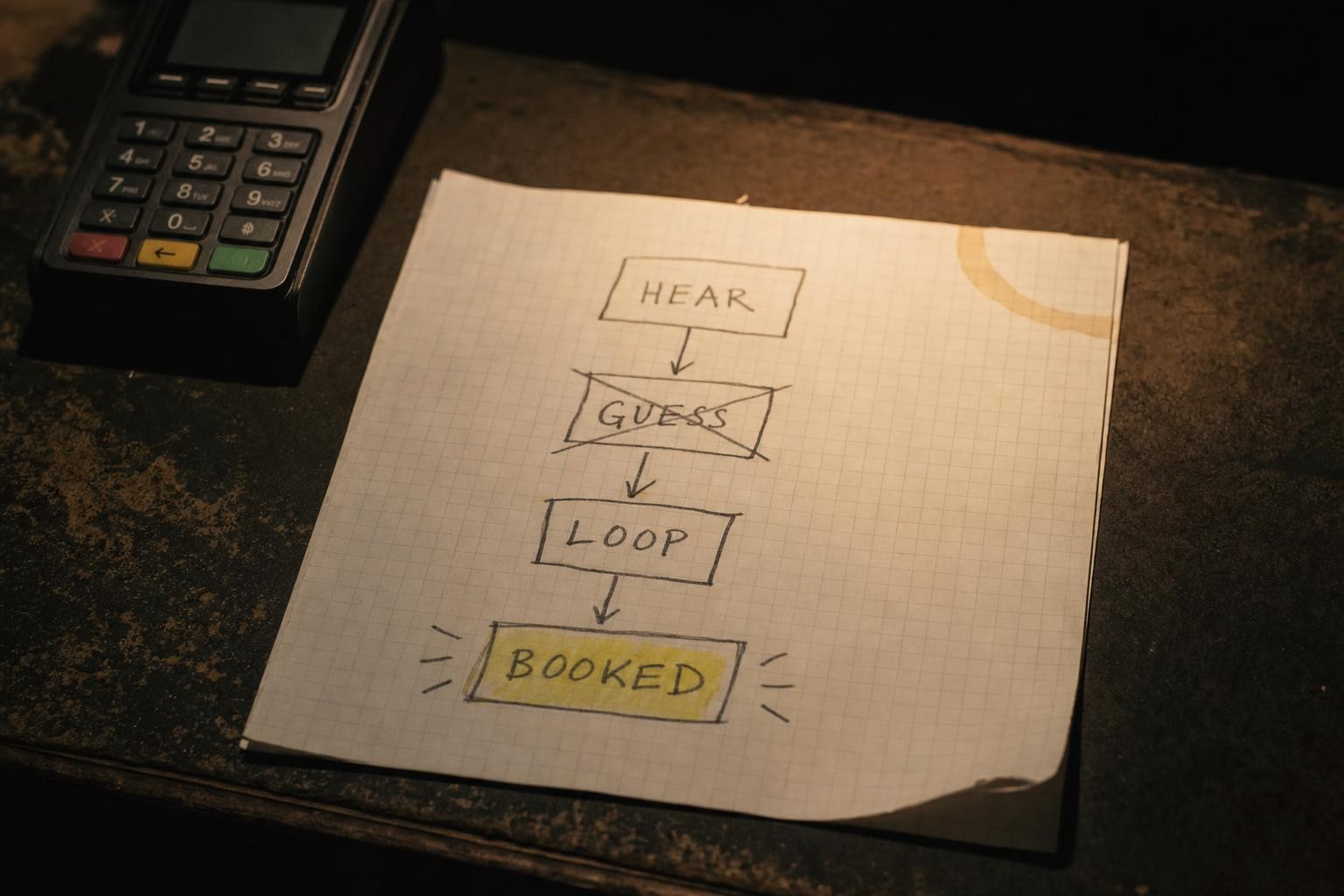
Option three: give the agent an explicit rule about what it cannot confirm. This is what we did for the catering business. The fix was not a smarter model or a more complex integration. It was a plain instruction added to the agent’s behaviour: it does not confirm orders, times, availability or prices. Instead, it tells the caller that the owner will call back to confirm, takes the details, and passes the request on. The caller hears something like: “I’ve got your order details and the owner will call you back to confirm, usually within a couple of hours.” That is honest, it sets an expectation, and it protects the business’s word.
Why option three is the right call
It costs nothing to add this rule. You are not rebuilding the agent. You are drawing a line between what the agent is allowed to handle on its own (taking details, answering general questions, booking a callback) and what requires a human to agree before it becomes a promise. That line should have been there from the start.
The caller experience is actually better, not worse. A caller who hears “I’ll pass that to the owner and they’ll confirm with you” knows where they stand. A caller who hears a confident confirmation and then gets a correction call is confused and, often, annoyed. Managed uncertainty is easier to live with than a broken promise.
There is a broader principle here. Every AI phone agent has an implicit scope: the things it genuinely knows and the things it is guessing at. The job of whoever sets up the agent is to make that scope explicit, in the agent’s instructions, so the agent never wanders into territory where its confidence outpaces its authority. Confidence is not the same as authorisation.
What to check in your own agent’s scripts
Go through your agent’s responses and look for any sentence that contains a confirmation, a time, a date, a price, or the word “confirmed”. Ask yourself: has a member of staff actually agreed to this, or is the agent inferring it? If it’s an inference, add a rule. The rule should do two things:
- Tell the agent it cannot use that confirmation language until a human has agreed.
- Give the agent the exact words to use instead, so it does not go quiet or sound evasive. “I’ll pass your details to [name or role] and they’ll call you back to confirm” is enough.
That second part matters. An agent that has been told it cannot confirm something, but has not been given an alternative, will often produce a vague or awkward response. Write the alternative in. Make it specific. Make it something you’d be happy for a customer to hear.
One thing to do today
Pull up the last ten transcripts from your AI agent. Search for the word “confirmed”, or any sentence that states a time, a date, or a price. For each one, ask whether a member of staff had actually agreed to that before the agent said it. If the answer is no for even one of them, you have a rule to add.
If you’d like a second pair of eyes on your agent’s scripts, I’m happy to look at them with you and point out anywhere the agent is making promises it shouldn’t. One conversation, no commitment. Find out how we build and tune AI receptionists here, or share this article with whoever manages your agent’s setup. The question to answer is simple: does your agent know the difference between taking a request and confirming one?