
 Bad Boy Labs
The worry most trade business owners have about AI answering their phone isn't the voice. It's this: will it actually collect what I need, or will it have a lovely conversation and hand me back a name and nothing else?
The real problem
You've got five questions that matter before you can quote a job. What's the work? Where is it? How urgent is it? What's the property type? And how did they find you? Miss any of them and you're calling back to fill gaps, or worse, you're quoting blind. A human receptionist who knows your business asks those questions without thinking. The question is whether anything else can do the same, reliably, on every call, at eleven at night when you're not picking up.
Work out what that gap costs you. Take the number of missed or poorly-handled calls you get in a week. Multiply by your average job value. Even if only a fraction of those are real leads, the number you land on is probably uncomfortable. That's the problem we're solving for, and the method matters.
Three ways to handle it
A human receptionist or call-handling service. This is the gold standard for caller experience. A good one asks the right questions, handles an awkward caller and uses judgement. The trade-off is cost, which for a dedicated service adds up quickly, and availability. Most services cover business hours. A caller at 9pm on a Sunday either goes to voicemail anyway or costs you significantly more to cover. If your missed-call problem is concentrated outside hours, a human service only partially solves it.
An answerphone or basic voicemail. Free, always on, zero effort to set up. It also loses a meaningful share of leads. Most callers don't leave a message. The ones who do leave a name and a number and nothing else, so you're still calling back blind. For a trade business competing on response speed, voicemail is the option that costs you the least to run and the most in lost work.
An AI agent with a scripted intake. An AI voice agent, a software system that answers calls and speaks with the caller in real time, can be configured to ask specific questions in a specific order and hand you a structured summary. It's available around the clock, asks the same questions every time and doesn't get flustered. The catch is that “configured to ask specific questions” is doing a lot of work in that sentence. How you structure those questions matters more than you'd expect.
What actually broke in testing
During the build of an AI phone receptionist for trade businesses, we ran the agent through a five-question intake script. The agent was friendly, the voice was natural, and on early test calls it reliably asked questions one, two, three and four. Question five was hit and miss.
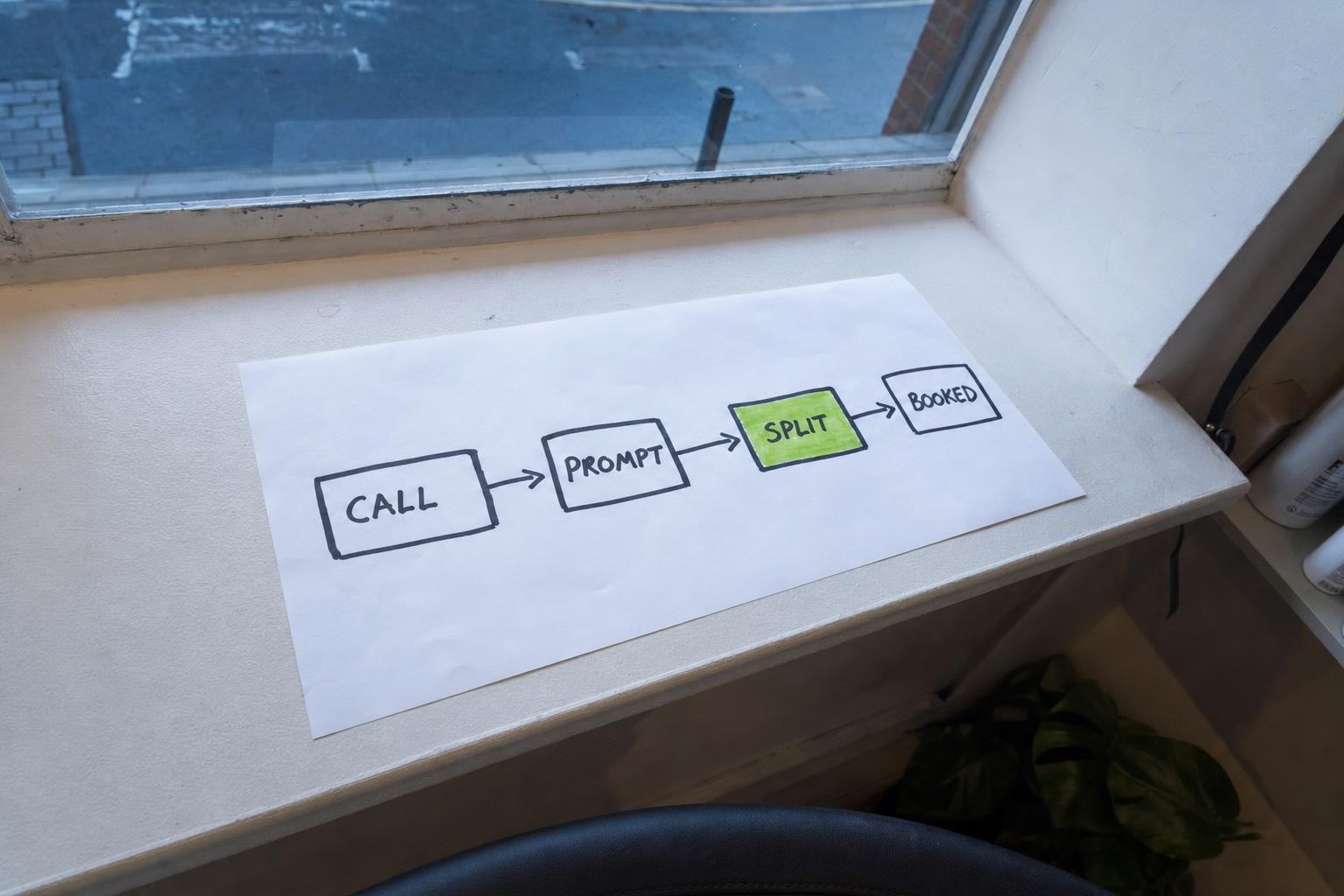
The reason was structural, not a bug. The questions had been grouped into a single combined prompt, one instruction containing multiple asks. The agent would work through the first few, then drift or wrap up early. The fix was to split each question into its own sequential step, a separate instruction the agent had to complete and confirm before moving to the next. Once that change was made, all five questions landed on every call.
Two other specific fixes came out of the same testing:
- Urgency became a mandatory 1-to-5 rating. When urgency was open-ended (“how urgent is the job?”) the caller's answer was hard to act on. “Pretty soon” tells you nothing. Framing it as “on a scale of one to five, where one is no rush and five is today” gives you a number you can triage against.
- The postcode gets read back once. Addresses get misheard. The agent now repeats the postcode back to the caller before moving on. One step, takes three seconds, catches the kind of error that sends an engineer to the wrong town.
There was one separate issue that briefly left a line half-live. The voice platform's keyword matching, the mechanism that routes a call to the right handling logic, rejected a keyword string that contained a space. A label like Site Rescue:3 failed silently where Rescue:3 passed. Not a logic error, just a platform quirk that only showed up when the line was live. It was fixed in minutes once identified, but it would not have shown up on a spec sheet review.
The recommendation
If you're considering an AI receptionist for your trade business, the spec sheet is not the test. The test is a real call, or as close to one as you can get before you go live. Call it yourself. Call it as a difficult customer. Call it at the question you most need answered and see whether the agent gets there.
The technology works. But “configured correctly” is a build decision, not a default setting. An agent that asks four out of five questions reliably is not the same as one that asks all five. The difference is in how the script is structured, and that only shows up under test.
For trade businesses specifically, the intake questions that matter most are usually the ones that let you decide whether to take the job and how to price it. If those aren't landing on every call, the agent isn't doing its job, regardless of how natural the conversation sounds.
Want to hear it for yourself?
We can run a demo call built around your actual intake questions, the ones you'd give a new receptionist on their first day. You'll hear whether it asks all of them, in order, and handles a caller who doesn't answer cleanly. No commitment involved: if it doesn't do what you need, you'll know before anything goes live. Find out what's involved on the services page and we can set up a call from there.