A Surrey business that serves several towns should run one Google Business Profile, set as a service-area business with the address hidden if customers never visit you, list the towns you actually drive to, and back each listed town with a real page on your website. The map pack a searcher sees depends on where they are standing, so a profile pinned in Shepperton will not appear for a search made in Guildford, whatever you type in the service area box.
What a missing town costs you
A Google Business Profile is the free listing that appears in the map pack, the block of three businesses with a map that sits at the top of a local search. If you are in it for a town, you get the calls. If you are not, you do not, no matter how good your site is. Here is a worked example for a plumber based in Shepperton who covers the towns within a short drive. The search volumes are real (UK, 2026 run-rate). The call-out value is verified at £80 to £150. The win rate is an assumption, so change it to yours.
| Search term | Searches a month (UK, 2026) |
|---|---|
| plumber weybridge | 144 |
| plumber walton on thames | 129 |
| plumber staines | 115 |
| plumber addlestone | 90 |
| plumber egham | 80 |
| plumber chertsey | 69 |
| plumber sunbury | 38 |
| plumber shepperton | 28 |
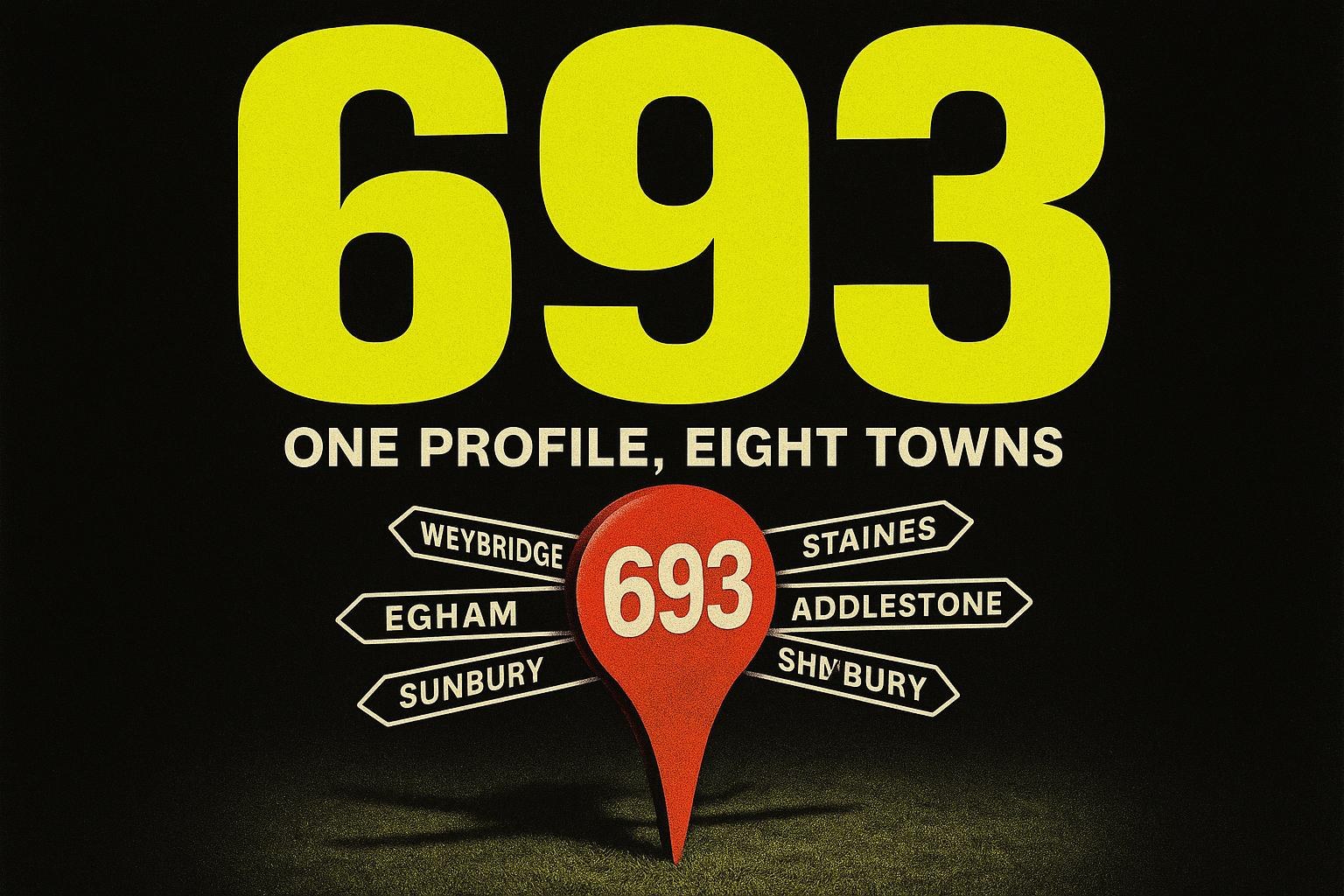
| Total across the patch | 693 |
Shepperton on its own is 28 searches a month. The surrounding seven towns are 665. A plumber whose profile only wins the Shepperton pack is competing for 4% of the searches on their own doorstep.
Example: appear in the pack for Weybridge and Walton as well as Shepperton
(144 + 129) searches x 10% who call the first result (assumption)
= 27 extra calls a month
x 40% booked (assumption) x £100 call-out (verified range £80 to £150)
= £1,080 each month, before any of the repair work that follows a call-out
Why does this matter more than the website? Because the map pack sits above the ordinary results, and on a phone it fills the screen. We set out why the profile outperforms the website for a local trade in a separate piece.
What the data says: the pack changes with the searcher's feet
On 13 October 2026 we pulled the Google Maps results for "web design" from two spots in Surrey. The point is not web design. The point is what changes.
From Guildford, the pack returned 20 businesses. The top 15 are all in GU1 or GU2 postcodes: NXT Digital Solutions (10 reviews) at number one, evince (141 reviews) at two, UP THERE, DIGITAL (13 reviews) at three. Not one business from north Surrey appears.
From Shepperton, with a 5 km radius, the pack returned 15 businesses: Surrey Web Designs in Weybridge (52 reviews) at one, Surrey Website Design (11 reviews) at two, KT12 Digital Design Agency in Walton-on-Thames (13 reviews) at three, Legacy Design Agency in Staines (21 reviews) at four. Not one Guildford agency appears, including evince with its 141 reviews.
Two lessons sit inside those lists. First, distance beats reviews. NXT Digital with 10 reviews outranks evince with 141 in Guildford, and Freelance-Creator with 108 reviews sits at number 15 from Shepperton. Google ranks the pack on three things it has described publicly: relevance (does your category and text match the search), distance (how far you are from the searcher or the place they typed), and prominence (reviews, ratings and mentions). A huge review count does not overcome being in the wrong place.
Second, the service-area box does not move your pin. Several agencies in the Shepperton list name "Surrey" in their business name. They still rank by where their pin sits. Listing Guildford in your service area tells Google you will go there. It does not put you in the Guildford pack for a searcher stood on Guildford High Street.
For the profile itself, the demand is real: "google business profile" is searched 74,000 times a month in the UK, mostly by people logging in. "Setting up google business profile" gets 480, "google business profile management" 91, "google maps seo" 80 and "google business profile optimisation" 79 searches a month (UK, 2026 run-rate).
Address or service area: which one are you?
Google splits profiles into two kinds, and getting this wrong is the most common reason a Surrey trade gets suspended or buried.
- A storefront business serves customers at its address. A shop, a clinic, a salon, an office people visit. Show the address.
- A service-area business goes to the customer. A plumber, an electrician, a roofer, a mobile dog groomer, a cleaner. Google's guideline is to hide the address and set a service area instead, because the address is your home or a yard, not somewhere a customer can walk in.
- A hybrid does both. A podiatry clinic that also does home visits. Show the address and set a service area.
Google lets you list up to 20 service areas by town, borough or postcode, and asks that the whole area sits within about two hours' drive of where you are based. The ranking consequence is the part people miss: with the address hidden, Google still ranks you from the place your profile is registered. Hiding the pin does not spread you across the county.
Three ways to cover several towns
Option 1: One profile, home town only, and leave it
What it means: your pin is in Shepperton, the service area is blank or just "Surrey", and the site has one Areas We Cover line in the footer. How you know it is a real choice: it is what most trades have today, and it still wins the pack in the town the pin sits in. Where it falls down: the numbers above. For a Shepperton plumber that is 28 of 693 searches a month. Who it is right for: a business that is full, or one that genuinely works one town.
Option 2: A profile in every town
What it means: registering a separate profile with an address in Weybridge, another in Staines, another in Walton, using a mate's address, a virtual office or a van. How you know people do it: look at any pack and you will find agencies with "Surrey" in the name and a serviced-office address. Where it falls down: Google's guidelines only allow a profile for a location that is staffed during stated hours and that customers can visit. A profile at an address you do not occupy is a fake listing. When it is reported, and competitors do report them, every profile you own can be suspended together, including the real one. You lose the 28 searches as well as the 665. Who it is right for: a business with a genuine second premises, staffed, with its own phone. Then it is not a trick, it is a second branch.
Option 3: One honest profile plus a page per town
What it means: one service-area profile with the pin where you really are, the towns you drive to listed as service areas, and a real page on your website for each of those towns that says what you have done there. How you know it works: the pack is ranked by distance from the searcher, but the ordinary results beneath it are ranked by relevance to the typed town. A "plumber Weybridge" page can rank in the ordinary results for Weybridge even when the Shepperton pin cannot make the Weybridge pack. The page and the profile reinforce each other, because Google reads the website linked from the profile when it decides relevance. Where it falls down: it takes an afternoon per town to write a page that is actually about that town, and a copied page with the town name swapped does not count. We explained what a town page needs in web design in Staines: getting found by the town next door. Who it is right for: any business that serves three or more towns and wants the searches in all of them.
The recommendation
Bottom line: option 3, every time, because it is the only one of the three that wins the other towns without risking the profile you already have. In money, for the example plumber, it is the difference between competing for 28 searches a month and competing for 693. In time, it is one hour on the profile and an afternoon per town on the site. If you are deciding whether to fix the profile or the website first, the answer is the profile, and we set out why in Google Business Profile or website first.
How to do it this week
- Decide which kind of business you are. Do customers come to you? Show the address. Do you go to them? Hide it. Both? Show it and add a service area. Done looks like: you can say which of the three you are in one sentence.
- Set the service area. Go to business.google.com, open your profile, click Edit profile, then Location and areas. Under Service area, add each town by name: Weybridge, Walton-on-Thames, Staines-upon-Thames, Addlestone, Egham, Chertsey, Sunbury-on-Thames, Shepperton. Up to 20. Do not type "Surrey" and stop; a county is too vague to help. Done looks like: a list of named towns, each one somewhere you have done a job in the last year.
- Hide the address if you are a service-area business. On the same screen, under Business location, turn off "Show business address to customers". Done looks like: the public profile shows the service area, not a house.
- Pick the right primary category. Click Edit profile, then Business category. The primary category is the biggest single ranking factor you control. "Plumber", not "Contractor". "Podiatrist", not "Health consultant". Add secondary categories only for things you actually do. Done looks like: a customer reading the category would know what to ring you for.
- Write one page per listed town. On your website, create a page at /plumber-weybridge or similar for each town in your service area. In four or five paragraphs: what you do there, a job you did there, the streets or estates you know, a review from a customer there, and your phone number above the fold. Link every town page from your homepage. Done looks like: each page could only be about that town.
- Get three reviews that name a town. Share your review link with your last ten customers and ask them to mention where the job was. Done looks like: reviews that read "boiler swap in Addlestone", not just "great service".
- Check from the customer's side. On your phone, with location on, search "plumber near me" from each town you serve, or type "plumber weybridge" from anywhere. Note where you appear: pack, ordinary results, or nowhere. Done looks like: a dated note with a result per town. "Nowhere" in a town is useful; it tells you which page to write next.
Our 30-minute profile setup covers the fields not mentioned here: hours, photos, the description and the phone number format.
Mistakes we see
- Stuffing towns into the business name. "Smith Plumbing Weybridge Walton Staines" breaks Google's naming rule and gets the profile suspended. The name is your trading name, nothing else.
- Listing half of England as a service area. Twenty towns you would never drive to dilutes the signal and sends you enquiries you have to turn down. List where you actually work.
- Hiding the address when customers do visit. A clinic that hides its address drops out of the pack for its own town. Hide it only if nobody comes to you.
- A different phone number on the profile and the site. Google reads both. Mismatched details read as two businesses and cost you trust in both.
- Town pages that are the same page. A template with the town name swapped is thin content. Google either ignores it or marks the site down. One real paragraph per town beats five copies.
Want the towns checked?
Tell us your trade and the towns you serve. We will search each one the way a customer would, from that town, and send you a one-line result per town: pack, ordinary results, or missing. That tells you which page to write first. If you would rather do the checks yourself, step 7 above is the method, and the Google Business Profile page has the full field list. Which do you want: the town-by-town check, or the field list?