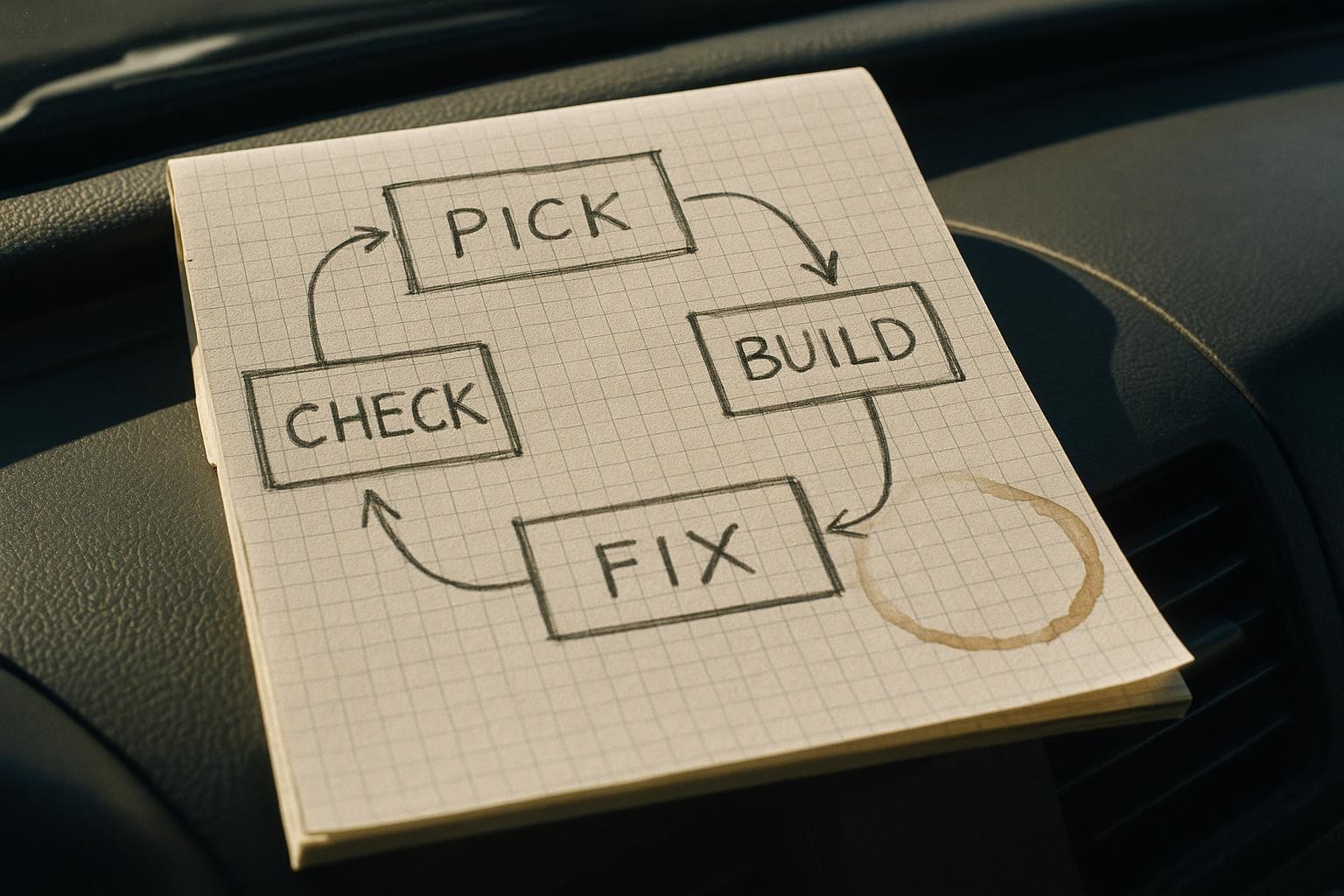
A CRM for tradesmen has to do four jobs and nothing else: chase every quote, send every annual reminder, ask every happy customer for a review, and catch every missed call. A CRM is the list of every customer, quote and job in one place, with what happens next written against each. If the tool you are looking at does those four without you typing in the van, it is right. If it needs an hour of admin a night, it is a second job.
What an unchased quote costs a trade
Every trade has the same leak. You price the job, send the quote from the van, and move on to the next one. The customer meant to come back to you. Three weeks later they went with the firm that rang on Thursday. You never find out.
Here is an example, labelled as an example, in a roofer's numbers. The average new roof is £8,000 (verified range £4,000 to £19,000). Say you send ten quotes a month and four are never chased. Say that chasing those four would win one of them. That win rate is illustrative; put in your own.
Unchased quotes a month:     4
Won if chased (example):     1 in 4 = 1 job
1 x £8,000 x 12 months = £96,000 of roofing a year
Now the smaller leak, which is the one plumbers feel. A call-out is £80 to £150 (verified). Say you have 200 past boiler customers and nobody reminds them the service is due. Say a reminder brings back one in five.
200 x 0.2 = 40 services
40 x £115 (midpoint of £80 to £150) = £4,600 a year, plus the repair work those visits find
Neither leak is a skills problem. Both are a list problem. The quote was never put somewhere that would nag you on day three. The customer's install date was never put somewhere that would nag you in eleven months. That is the whole job of a trade CRM, and it is why the admin has to be near zero: you are the one on the roof.
What the search data says about trades and CRMs
UK Google searches each month, 2026 run-rate, checked 13 October 2026:
| Search term | Searches a month (UK) | Cost per click to advertisers |
|---|---|---|
| plumber woking | 508 | about £9.83 |
| crm for small business | 502 | |
| plumber kingston | 448 | about £15.12 |
| plumber surrey | 420 | about £5.05 |
| electrician woking | 359 | about £7.42 |
| electrician surrey | 334 | about £4.75 |
| web design for tradesmen | 308 | about £6.70 |
| website for tradesmen | 281 | about £9.26 |
| crm for tradesmen | 22 | about £87.74 |
Two readings. First, almost nobody searches for "crm for tradesmen": 22 a month in the whole country. Trades do not think they want a CRM. They think they want the quote chased and the phone answered, which is the same thing with the jargon removed. Second, look at the click cost. Advertisers pay about £88 for one click on those 22 searches, more than ten times what a plumber pays for "plumber woking". The software vendors know a trade that signs up stays for years. That is why your inbox is full of apps. It is not evidence that you need one.
The honest local fact: "automation Woking", "automation Weybridge" and every other Surrey town return effectively zero searches. Nobody is typing this locally, so decide on your own numbers, not on what the market is doing.
The four things a trade CRM must do
- Quote follow-up. Day three: "Any questions on the quote?" Day ten: "Still want the job done this month?" Both go out without you remembering. The roofing quote follow-up system walks through the exact messages.
- Annual reminders. Boiler service, gutter clear, electrical check. Eleven months after the job, a message goes out with a link to book. The annual service reminder for plumbers covers the setup.
- Review requests. The day the job is invoiced, a message with your Google review link. Reviews win the next job on Google Maps; the plumber with 80 reviews outranks the plumber with 8.
- Missed-call capture. A call you cannot take sends the caller a text within a minute and creates a record so you ring back from the list, not from memory. For a Surrey plumber that one message is the difference between the £80 to £150 call-out and the customer ringing the next name.
Anything else, pipelines with nine stages, lead scoring, dashboards, is for sales teams. A trade needs those four and a diary.
Three ways to run it
One problem: quotes, reminders, reviews and missed calls are handled from memory. Three options, two of them not us.
Option 1: WhatsApp and a notebook
What it means. What most Surrey trades do now. Quotes go by WhatsApp. Jobs go in a diary or a notebook. Reminders happen if you remember.
How you know it works. Scroll back through WhatsApp to every quote from the last 30 days. If each one has a follow-up message from you on day three or so, it works. Most people doing this check find half have no follow-up.
Where it falls down. The scroll. WhatsApp is a conversation, not a list. There is no view of "all quotes with no reply", no reminder in eleven months, no record of the missed call while you were under a floor. It works until the week you are busy, and busy is exactly when the quotes are worth the most.
Right for. A sole trader with a full diary who turns work away. If you are already booked three weeks out, chasing quotes harder is not your problem.
Option 2: a trade job-management app
What it means. The apps built for trades: quote, schedule, invoice, customer list in one place, on the phone. Several are well known in the UK. Most have a free trial and bill per user monthly. Their pricing pages were not fetched tonight, so no figures here; check the vendor's own page and read the per-user line carefully.
How you know it works. Three checks. The app sends the day-three quote chase on its own. It sends the eleven-month reminder on its own. It sends the review request when the invoice is marked paid. If any of those three needs you to remember, you have bought a diary with a logo.
Where it falls down. The phone and the gaps. Most trade apps do not know a call was missed, and most cannot text the caller back. They also tend to do quotes and invoices well and follow-up badly, because they were built by accountants, not by someone who lost a roof to the firm that rang on Thursday. And the data lives in the app: if you leave, you export a spreadsheet and start again.
Right for. A trade with two or more people, where scheduling and invoicing are the daily pain and follow-up is the secondary one. This is most small firms, and the honest answer for most of them is this option, provided the three checks above pass.
Option 3: a built system around the phone
What it means. Whatever app or list you already use, with the phone wired into it. A missed call creates the record and texts the caller. A quote sent from the app starts the chase on its own. The install date starts the reminder clock. The paid invoice sends the review link. And when you are on a roof, an answered phone, a receptionist that picks up and books, feeds the same list. This is what Bad Boy Labs calls CRM Integration, described on the CRM automation page, and for plumbers specifically on the plumbers' receptionist page.
How you know it works. Count messages you typed by hand this week. Count quotes from the last 30 days with no chase. Count calls that rang out with no text back. All three should be close to zero, and you should not have done the counting yourself; the list should show it.
Where it falls down. It needs you to say, in writing, what happens when a quote goes out and when a call is missed. If that is not written down, nothing can be built. It is also too much for a sole trader doing five quotes a month, where option one is enough and anyone selling you more is selling a day rate.
Right for. A trade sending ten or more quotes a month, missing calls because the phone is in the van, and losing jobs it never hears about.
Which one should you pick?
Bottom line: a trade app is right for most firms, provided it chases quotes and sends reminders on its own; wire in the phone only when missed calls are the leak you keep paying for.
The reason is in the two sums. The roof example loses £96,000 a year to quotes nobody chased, and a trade app that sends the day-three message fixes that for the cost of one app subscription. The missed-call leak is different. No app can text a caller it never heard about, so if the phone is where your enquiries die, the wiring is the only option that touches it. Pick the cheapest option that covers your biggest leak, then stop.
How to fix quote follow-up this week
- Find your unchased quotes. Open WhatsApp, email and your app. List every quote from the last 30 days with no reply and no follow-up from you. Done looks like: a number, probably bigger than you expected.
- Send the day-three message to every one of them today. "Hi [name], just checking you got the quote for the [job]. Happy to answer anything. Still able to start the week of the [date]." Done looks like: the message sent to the whole list within the hour.
- Write the four messages once: day three chase, day ten chase, eleven-month reminder, review request. Keep each under 50 words. Done looks like: four messages on one note on your phone.
- Put every quote in one list with a date. A sheet with Name, Phone, Job, Quote sent, Chase 1, Chase 2, Outcome, or the quotes view in your app. Done looks like: every quote from this week is a row.
- Turn on automatic follow-up in your app if it has it. Usually under settings, then quotes or automations. Set day three and day ten. Test it by sending a quote to yourself. Done looks like: your own phone receives the chase on day three.
- Set the missed-call text. If your phone system or app can send a text to a missed caller, turn it on: "Sorry I missed you, I am on a job. Reply with your postcode and the problem and I will call you back within the hour." Done looks like: ring your own number from another phone, let it ring out, and receive the text.
- Review on Friday. Quotes sent, quotes chased, quotes won, calls missed, texts sent. Five numbers. If calls missed is high and texts sent is zero, that is the leak to fix next, before anything else. Old quotes and cold leads covers what to do with the quotes older than 30 days.
Mistakes we see with trade CRMs
- Buying the app for invoicing and never turning on the follow-up. The follow-up is the bit that makes money. Invoicing just collects it.
- Nine pipeline stages. A trade needs three: Quoted, Booked, Done. Everything else hides a job.
- Reminders that never start. The install date was not entered, so the eleven-month clock never ran. Enter the date on the day you invoice.
- Review requests sent weeks later. Ask on the day the job is finished and paid, while the customer is still pleased. A fortnight later the moment has gone.
- Ignoring the missed-call column. The app says ten enquiries. The call log says thirty. The twenty in between are the expensive ones.
So, a decision. Count the quotes from the last 30 days with no follow-up and the calls that rang out with no text back. If both numbers are near zero, you do not need anything here. If either is more than a handful, do you want me to pull your call log and quote list for last month and show you, in pounds, which of the four jobs is leaking the most? Yes, and the CRM automation page shows what the wired-in version looks like. No, and step two above is still worth doing before you put the phone down tonight.