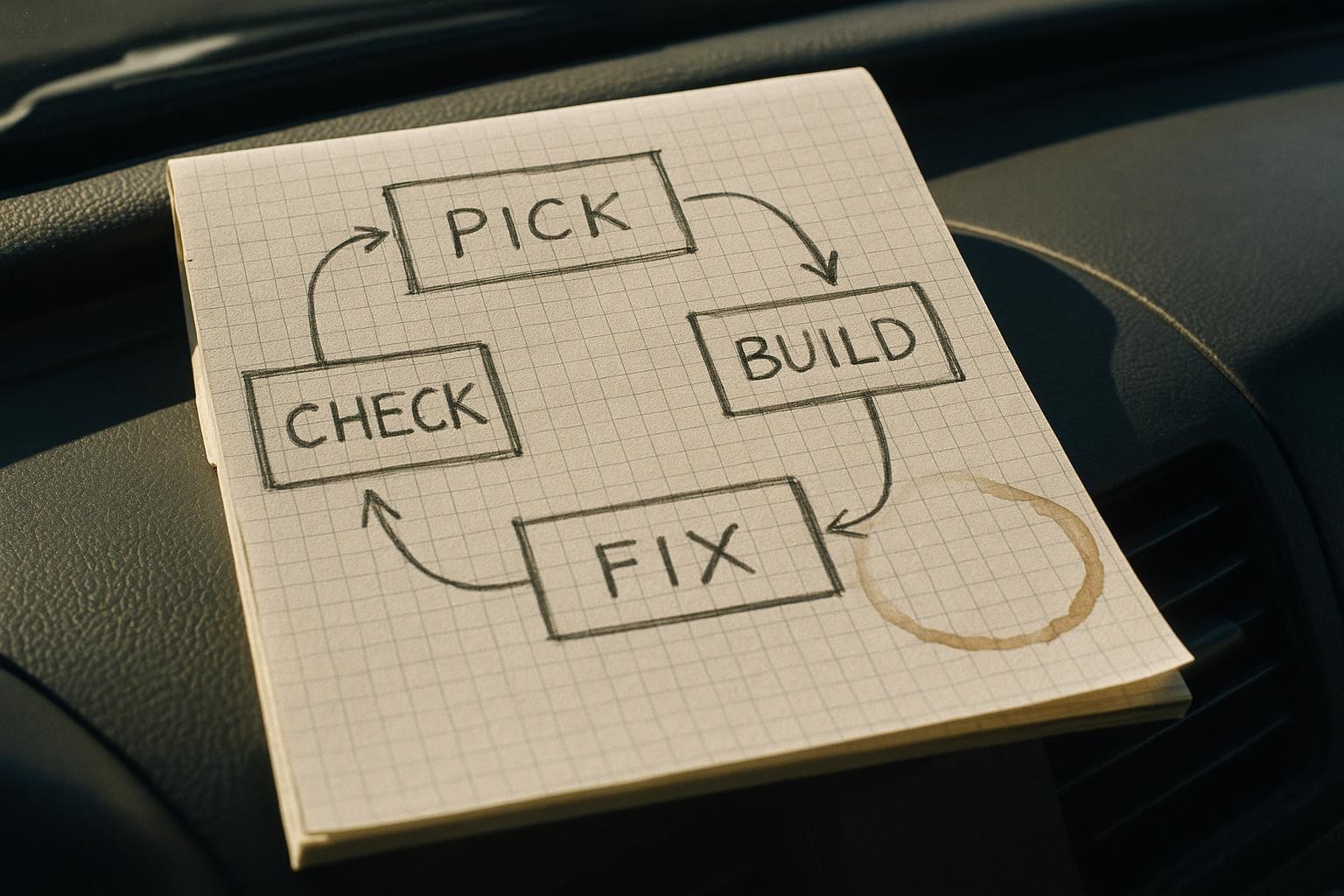
A day with an automation consultant should give you three things you can hold: a map of where hours and leads leak out of your business, one system scoped to the point where you could build it or brief it, and a written list of what not to automate. If you get a slide deck and a proposal instead, you paid for a sales call. Automation here means software doing a repeatable task, such as copying a booking into the invoicing system, without a person doing it by hand. The day is wasted in one specific case, and it is the most common one: nothing is written down.
What re-keying actually costs an ops team
Most firms do not have an automation problem. They have a copying problem. The booking goes in the diary, then gets typed into the job sheet, then typed into the invoice, then typed into the spreadsheet for the accountant. Four times, same name, same address, same date.
Here is an example, labelled as an example, for a three-person office. Say each person spends 40 minutes a day moving information between systems that do not talk to each other.
3 people x 40 minutes x 5 days = 10 hours a week
10 hours x 48 working weeks = 480 hours a year
480 hours = 60 working days of eight hours
Sixty working days a year. That is one person's quarter. Put your own hourly cost against it and that is the number the consultant's day has to beat. It usually does, by a wide margin, but only if the day produces something that gets built. A day that produces a document nobody acts on has cost you the day rate plus the day of your time, and the 480 hours carry on.
What the search data says about automation consultants
UK Google searches each month, 2026 run-rate, checked 13 October 2026:
| Search term | Searches a month (UK) | Cost per click to advertisers |
|---|---|---|
| ai consultant | 1,850 | |
| automation consultant | 299 | about £10.65 |
| business automation | 244 | |
| email automation | 225 | about £47.36 |
| whatsapp business automation | 28 | about £22.88 |
| crm setup | 21 | about £81.64 |
| workflow automation agency | 11 | about £12.97 |
| zapier consultant | 11 | |
| n8n consultant | 10 |
Three readings. First, "ai consultant" gets six times the searches of "automation consultant". The word has changed; the job has not. Most of what an AI consultant does for a small firm in 2026 is automation with a language model somewhere in the chain. Second, the specific tool terms are tiny: "zapier consultant" 11, "n8n consultant" 10. Owners do not search by tool, they search by problem, so judge a consultant by the problems they have fixed, not the badges on their site. Third, "automation Woking", "automation Weybridge" and every other Surrey town return effectively zero searches. There is no local market by name. And when we checked Google on 13 October 2026, page one for "ai agency surrey" included a London agency at number one, a consultancy in Surrey, British Columbia at number four, and a Glasgow firm at number six. If you search locally you will get a mix of everywhere. Judge on output, not postcode.
What a good day actually produces
Three artefacts, each one a page or two, each one yours to keep:
- The leak map. Every place a lead, a booking, a document or a payment is copied by hand, with who does it, how often, and how long it takes. Twenty rows is normal. Sorted by hours a year. The top three rows are usually most of the total.
- One system, scoped. Not five. The row at the top of the leak map, written up as: what triggers it, what data moves where, what the person checks before it goes, what happens when it fails, and what "done" looks like. Written so you could brief a builder, or build it yourself.
- The no-go list. Things you asked about that should stay manual, with the reason. Anything that happens twice a year. Anything with no written process. Anything that moves money without a human check. The no-go list is the most valuable page, because it is the one that stops the £700 mistake. That article is the worked example.
What a bad day produces: a presentation about transformation, a list of twelve tools, and a proposal for a retainer. If the first hour is spent on your vision rather than your job sheet, that is the signal.
Three ways to get the leaks fixed
One problem: hours and leads are lost to copying between systems. Three options, two of them not us.
Option 1: free tools and a weekend
What it means. Most automation tools have a free tier and a drag-and-drop editor. You pick the worst leak, connect the two systems yourself, and test it with a real booking. Zapier, Make and n8n are the usual names; their pricing pages were not fetched tonight, so check the vendor's own page for what the free tier allows.
How you know it works. A real booking made on Monday appears in the invoicing system without anyone typing it, and still does on Friday. The Zapier vs Make vs custom builds article covers which tool suits which job.
Where it falls down. The second month. The first automation works. The fifth one breaks when a supplier changes a column name and nobody notices for three weeks. Free tiers also cap how many times a month the automation can run, so the one that matters stops on the 20th. And a weekend is rarely enough to write the process down first, so what gets built is the owner's memory of the process, not the process.
Right for. An owner who enjoys this, with one clear leak, under five staff, and the patience to check it every Friday. Honestly, this is the right answer for a lot of small firms, and the how to write down a process article is the prerequisite.
Option 2: a consultant day
What it means. One day, on site or on a call, producing the three artefacts above. No building. The output is paper you can act on with anyone.
How you know it works. At 5pm you have the leak map, the one scoped system and the no-go list, in writing, and you could hand the scoped system to a builder tomorrow. If you could not, the day did not do its job.
Where it falls down. The empty-handed day. If nobody in the firm can describe what happens when a booking comes in, the consultant spends the day finding out and leaves with a process document instead of a scope. That is useful, but it is not what you paid for, and it was avoidable. It also falls down if the firm has no one to own the build afterwards, so the scope sits in a drawer. The AI workflow audit article shows what the day looks like hour by hour.
Right for. Five to thirty staff, several systems that do not talk, a process somebody can describe, and a decision-maker in the room for the whole day.
Option 3: an agency scopes and builds
What it means. The same day, followed by the build of the one scoped system, with testing, monitoring (a check that tells someone when it stops working) and a handover. This is what Bad Boy Labs does under CRM Integration, on the CRM automation page: the phone, the forms, the diary and the invoicing feeding one list without a human copying.
How you know it works. Three months on, the re-keying hours in the leak map have actually fallen, the system has failed at least once and somebody was told within the hour, and your team can explain what it does without ringing the agency.
Where it falls down. Building before scoping. An agency that quotes a build on the first call has not seen your leak map, so they are pricing a guess. It also falls down when the firm wants everything automated at once. Five systems built together means five things that can break together. And it is too much for a three-person firm with one leak, where option one and a Friday check do the job.
Right for. A firm where the top leak is worth more than the build, nobody in-house will own a weekend project, and the systems involved include the phone, which free tools cannot hear.
Which one should you pick?
Bottom line: write the process down first, then buy the day, then build only the top row of the leak map.
The reason is in the hours sum. Sixty working days a year is lost in three or four leaks, not twenty. A consultant day that finds the top one and scopes it properly pays back in the first month of the build. A weekend with free tools pays back faster still, if the owner has the appetite. An agency build pays back when the leak involves the phone or money, where a free tool breaking silently costs more than the build. The option that never pays back is the one that starts before anything is written down.
How to prepare for the day this week
These three jobs are the ones to give a consultant first, and the preparation is what makes the day worth having.
- Job one: the lead path. Write down, in order, what happens from the moment the phone rings or a form arrives to the moment the job is booked. Who touches it, which system, how long. One page. Done looks like: a new starter could follow it.
- Job two: the booking-to-invoice path. Same exercise, from job booked to invoice paid. Count how many times the customer's name is typed. Done looks like: a number, usually three or four.
- Job three: the monthly report. Whatever you compile by hand for the accountant, the bank or yourself. List the sources and the hours. Done looks like: the sources named, the hours honest.
- Time each step for one week. A tally on paper is fine. Done looks like: minutes per day per person for each of the three paths.
- Export a sample. Ten real rows from each system, with personal details removed. The consultant needs to see the column names, not your customers. Done looks like: three small files.
- Book the decision-maker in for the whole day. If the person who can say yes is in for the first hour only, the scope will be wrong by lunch.
- Ask for the three artefacts by name when you book: the leak map, one scoped system, the no-go list. If the consultant does not know what you mean, book someone else.
Mistakes we see with automation consultants
- Booking the day before writing the process. The day becomes a discovery session and the scope never gets written.
- Scoping five systems. One gets built. Four sit in a document. Scope one, build it, then come back.
- No no-go list. Everything looks automatable on a whiteboard. The list of what to leave alone is where the judgement is.
- No one to own it afterwards. An automation nobody owns is a thing that fails quietly on a Tuesday and is found in the accounts in March.
- Judging by tools. A consultant who leads with the tool has decided the answer before seeing the question.
Here is the decision. If you can write the lead path and the booking-to-invoice path on one page each, this week, you are ready for the day and may not even need it; the top leak is often obvious once it is written down. If you cannot, the process document is the job, not the consultant. If you have written them and want the leak map done properly, do you want me to spend a day on your three paths and hand you the map, one scoped system and the no-go list? Yes, and the CRM automation page shows what gets built when the phone is the top row. No, and the one-page process is still the most valuable thing you can do this week.