A small business needs one of three CRMs: the free version if you have fewer than ten leads a week and one person chasing them, the cheap paid version if two or more people share the chasing, and a consultant only when the phone, the website forms and the diary need to feed one list automatically. A CRM is the list of every customer, enquiry and job in one place, with a note of what happens next. Most firms in Surrey never need the third version. Some do, and they are the ones losing enquiries between the phone and the inbox.
What a lost follow-up costs a small business
Forget the software for a minute. The problem a CRM solves is a human one: an enquiry comes in, somebody means to call back, and nobody does. In a firm with one owner and a mobile phone, that happens every week.
Here is an example, labelled as an example, in a podiatry clinic's numbers. A visit is £50 to £148 (verified range), and patients rebook every six to eight weeks, so one new patient is worth roughly seven visits a year. Take £90 a visit, inside the range. Say the clinic gets five new enquiries a week and one of them is never followed up because the voicemail was heard on Friday and forgotten by Monday.
1 lost enquiry a week x 52 weeks = 52 patients a year
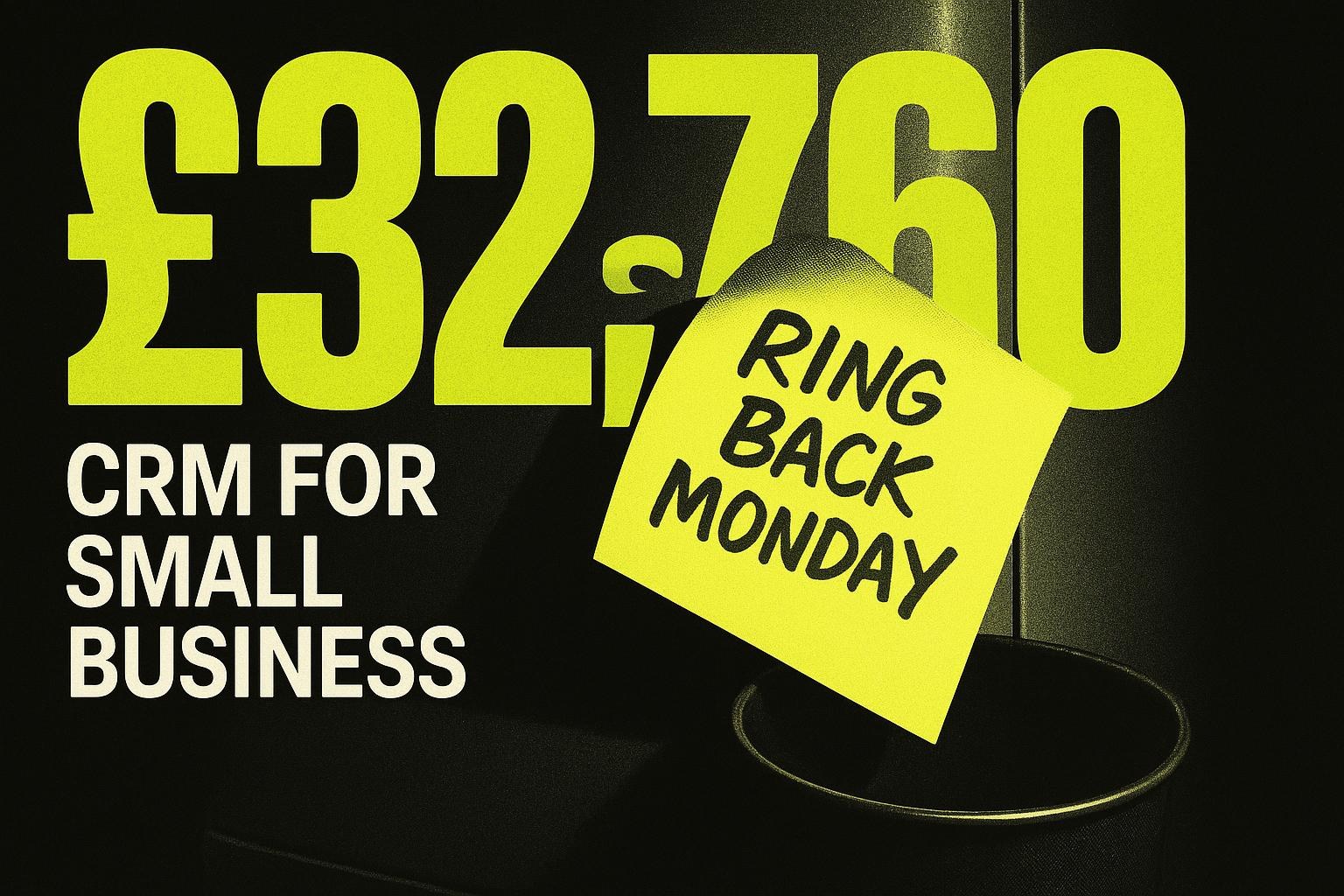
52 x 7 visits x £90 = £32,760 a year
That is not a software problem. It is a list problem. The enquiry was never written down anywhere that would nag someone on Monday morning. Change the trade and the figures move, but the shape is the same: a plumber's call-out is £80 to £150, a new roof averages £8,000, and in every case the enquiry that nobody chased is the one that cost the most.
What people actually search for, and what it tells you
UK Google searches each month, 2026 run-rate, checked 13 October 2026:
| Search term | Searches a month (UK) | Cost per click to advertisers |
|---|---|---|
| crm for small business | 502 | |
| crm consultant | 179 | about £75 |
| hubspot consultant | 171 | |
| crm consultancy | 126 | about £21.64 |
| best crm for small business uk | 89 | about £42.02 |
| crm for small business uk | 70 | about £38.54 |
| zoho crm consultant | 34 | |
| crm setup | 21 | about £81.64 |
| pipedrive consultant | 18 | about £24.37 |
| crm integration services | 12 | about £110.02 |
Read the right-hand column. Advertisers pay about £110 for one click on "crm integration services" and about £82 for "crm setup". Nobody pays that for a click unless the work behind it is worth thousands. That tells you two things: setup and integration are where the real money and the real difficulty sit, and the people selling it will find you before you find them.
Two more honest facts. "gohighlevel" runs at 22,200 searches a month, more than every CRM-for-small-business term combined, and its cost per click is about 66p, because most of those searches are from agencies reselling it, not from owners. And "crm consultant Shepperton", "crm consultant Woking" and every other Surrey town return effectively zero searches. The Google Maps results for "crm consultant" from Shepperton on 13 October 2026 were firms in Manchester, Peterborough, London, Beaconsfield, Harrogate, Brighton and Dublin. There is no local CRM consultant market. Whoever you hire will be remote, or a local firm that does this as part of something wider.
The three versions, honestly
One problem: enquiries are not being chased. Three options. Two of them are not us.
Version 1: the free CRM, set up by you
What it means. HubSpot's free CRM, checked on hubspot.com on 13 October 2026, allows up to two users and 1,000 contacts, needs no credit card and has no expiry date. It includes contact, deal and task management, deal pipelines, email templates, meeting scheduling, live chat and a form builder. Other vendors have similar free tiers. A shared Google Sheet with five columns is also a free CRM, and for a lot of firms it is the better one.
How you know it works. Every enquiry is in the list by the end of the day, with a next action and a date. On Monday morning the list, not your memory, says who to ring. If you can tick that sentence, the free version is working.
Where it falls down. Entry. The free CRM does not know a call happened. It does not know a form was filled unless you connect the form. Someone has to type every enquiry in, and the person who forgot to ring back is the same person who forgets to type it in. The free tier also stops at two users, so the moment a third person needs the list, you are paying.
Right for. Under ten leads a week, one person doing the chasing, enquiries mostly by phone. This is most sole traders and most two-person firms. If that is you, stop reading here, open a sheet and start writing enquiries down tonight.
Version 2: the cheap paid CRM, set up by you
What it means. The paid tier of the same tools. HubSpot's own product catalogue, checked 13 October 2026, lists Sales Hub Starter from $20 per seat each month. GoHighLevel, checked on its pricing page the same day, lists a Starter plan at $97 each month (or $970 a year) and Unlimited at $297 each month, both with a 14-day free trial. Pipedrive and Zoho sit in the same market. You pay for more users, automated reminders, and the ability to connect forms and email so some entries happen on their own.
How you know it works. Three signs. Two or more people see the same list. A web form creates a record without anyone typing. A reminder fires when a quote has had no reply for three days.
Where it falls down. Still the phone. Most Surrey trades and clinics get most enquiries by phone, and the cheap CRM only knows about a call if someone logs it. It also falls down on setup time. The tools are built for sales teams with pipelines and stages, and an owner spends a weekend configuring things they will never use. A CRM nobody updates is a monthly bill for a list that is wrong.
Right for. Ten to thirty leads a week, two or more people chasing, a fair share of enquiries arriving by web form or email rather than phone.
Version 3: an integrated CRM, built by a consultant
What it means. Integration is a dull word for a simple idea: the phone, the website forms, the booking diary and the email inbox all write into one list without a human typing. A missed call creates a record and sends the caller a text. A form fill creates a record and rings the owner. A quote with no reply for three days triggers a follow-up email. This is what Bad Boy Labs calls CRM Integration, described on the CRM automation page. The CRM itself can still be the free one. The work is in the wiring.
How you know it works. Count entries you typed by hand this week. If the answer is near zero, and the list is still right, the integration is doing its job. The test is the opposite of version one: the list fills itself.
Where it falls down. Two ways. First, it needs a written process. If nobody can say what should happen when a lead arrives, there is nothing to automate, and a consultant will spend a day finding that out at your expense. Read how to write down a process first. Second, it can be over-built. A ten-lead-a-week firm does not need the phone wired into anything. The honest answer for that firm is version one, and any consultant who says otherwise is selling a day rate. The wiring choices themselves are explained in Zapier vs Make vs custom builds, and the principle of adding to what you have rather than replacing it is in AI on top of your existing system.
Right for. Thirty or more enquiries a week, or fewer if most arrive by phone and get missed, or any firm where two systems (say, a booking diary and an email inbox) already disagree about who the customers are.
Which version is right for you?
Bottom line: start with the free version, move to the cheap version when a second person needs the list, and pay for integration only when the phone is the thing you keep losing enquiries from.
The reason is in the clinic sum. £32,760 a year walked out because one enquiry a week was not written down. The free version fixes that for nothing if one person can keep the list honest. It stops fixing it when the entries stop, and entries stop when the person doing them is also the person on the tools, on the phone and at the school gate. At that point, paying someone to make the list fill itself is cheaper than the enquiries it saves, and it is the only version that catches the phone.
| Signal | Version |
|---|---|
| Under ten leads a week, one person chasing | Free, or a spreadsheet |
| Two or more people chasing, forms and email a big share | Cheap paid tier |
| Phone is the main channel and calls get missed | Integrated, phone feeding the list |
| Nobody can describe what happens when a lead arrives | None yet. Write the process first. |
How to set up the free version this week
- Pick the tool. HubSpot free CRM (two users, 1,000 contacts, no card, checked 13 October 2026) or a Google Sheet. If you are unsure, the sheet. You can import it into any CRM later.
- Make five columns and no more: Name, Phone, What they want, Next action, Due date. Done looks like: a sheet you could explain to a new starter in one minute.
- Add every enquiry the same day. Missed calls included. Open your call log at 5pm, add anything not already in the list. Done looks like: the number of rows matches your call log plus your inbox.
- Set one rule for Next action. Every row has one, and it is a verb: "Ring back", "Send quote", "Chase quote". A row with no next action is a lost enquiry waiting to happen.
- Sort by Due date every morning. Do the overdue rows first. In HubSpot, this is the Tasks view. In a sheet, sort the column. Done looks like: zero overdue rows by 10am.
- Connect your website form if you have one. In HubSpot, Marketing, then Forms, then create a form and embed it, or use the free form builder on your site. Done looks like: a test enquiry from your own phone appears as a contact without anyone typing.
- Review on Friday. Count rows added, rows with no next action, and rows overdue by more than three days. If the third number is growing week on week, that is the signal to move up a version.
Mistakes we see with small business CRMs
- Buying the paid tier to fix a habit problem. If entries are not happening in the free version, they will not happen in the paid one either.
- Twelve pipeline stages. A Surrey plumber needs three: Enquired, Quoted, Booked. Every extra stage is a place for a lead to hide.
- Two lists. The diary has one version of the customer, the CRM has another, and the invoicing app has a third. Pick one as the source of truth and feed the others from it.
- Ignoring the phone. The CRM reports ten leads. The call log shows thirty. The twenty in between are the expensive ones.
- Paying a consultant before writing the process. A day rate spent discovering you have no process is a day rate you could have kept.
So, a decision. If you can honestly say every enquiry is written down by the end of the day with a next action, you do not need anything from this article beyond the sheet. If your phone is where enquiries go missing, and you want to know how many calls went nowhere last month before you spend a penny on software, do you want me to pull that number from your call log and show you where the list is leaking? Yes, and the CRM automation page explains what the integrated version looks like. No, and the five-column sheet above is still the right next step.