An after-hours answering service catches the calls that come in between 6pm and 8am, at the weekend and on bank holidays, when your phone goes to voicemail and the caller rings the next name. In the trades those are the expensive calls: the burst pipe, the roof after the storm, the patient who has finally sat down and decided to book. There are three honest ways to catch them, and the right one depends on how many ring out and what each one is worth to you.
What rings out after six
Between 6pm and 8am your phone is doing something specific: it is receiving the calls people make when they get home. The boiler that was fine at breakfast is dead at tea time. The pipe under the bath lets go at 9pm. The storm goes through overnight and the homeowner is in the garden at 7am looking at slates on the lawn. And the quieter kind: the couple who have had three roofing quotes on the kitchen table for a fortnight and decide, on Sunday evening, which one to ring. The patient whose feet have hurt all week and who, at 8pm, searches for a podiatrist and rings the first one that answers.
Those callers share one habit. They do not leave voicemails. They ring the next number. By 8am the pipe is fixed by someone else, the roof is booked with someone else, and the patient has an appointment somewhere else. You never see the call as a lost job. You see it as a missed call from a number you do not know, if you look at all.
The problem in your money: a worked example
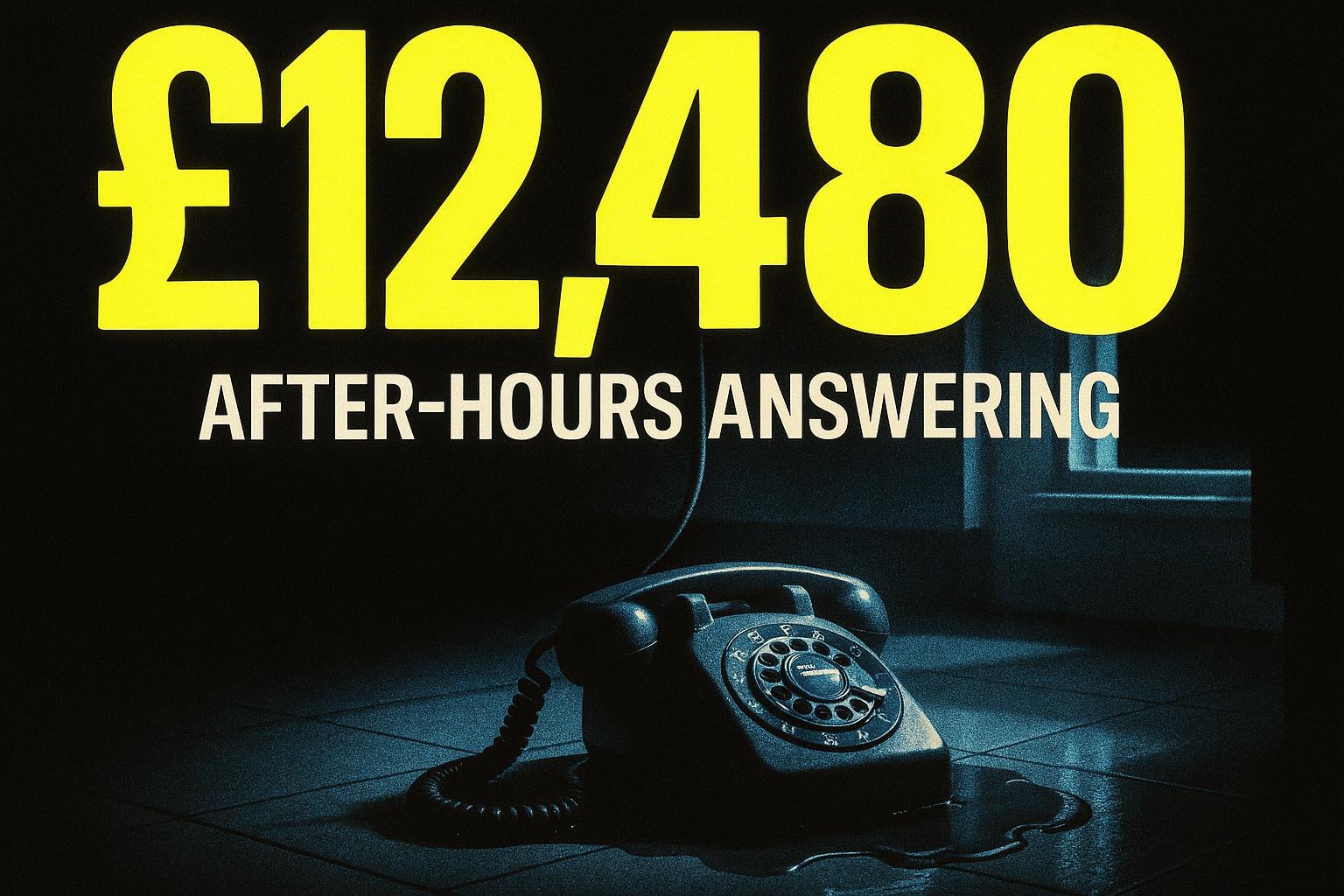
This is an example; put your own figures in. A plumbing firm, two vans, owner on the tools and off the phone after 6pm. The call log shows four calls a week ringing out between 6pm and 8am or at the weekend. A standard call-out sits between £80 and £150, so use £120. Say half of those callers would have booked had someone answered.
4 after-hours calls x 0.5 would book x £120 call-out x 52 weeks = £12,480 a year
Now a roofer. A new roof averages £8,000 (range £4,000 to £19,000). The storm season brings the calls at night and first thing. Say one call a month that rings out would have become a roof:
1 roof x £8,000 x 12 months = £96,000 a year
And a podiatry clinic, where the story is lifetime value rather than one fee. A visit runs from £50 to £148; use £90. Patients rebook every six to eight weeks, which is roughly seven visits a year. Say two new-patient calls a week ring out after closing and one of them books elsewhere:
1 lost patient x £90 x 7 visits = £630 a year per patient
x 52 weeks = £32,760 a year
The three sums have the same shape: calls that ring out, a share that would have booked, and what a booking is worth in your trade. The plumber's £12,480 is the modest one, and it still covers a lot of answering. What missed calls cost your business walks through the method for any trade, and the calculator does the arithmetic with your own numbers in seconds.
What the data says in 2026
UK search volumes from Google Ads data, 2026 run-rate, checked on 13 October 2026:
| Search | Searches a month (UK, 2026 run-rate) |
|---|---|
| telephone answering service | 529 |
| ai answering service | 99 |
| ai phone answering | 86 |
| after hours answering service | 79 |
| 24 hour answering service | 70 |
| call answering service for small business | 48 |
| answering service plus any Surrey town | effectively zero |
What that means in plain terms: the after-hours problem is searched for as a general "answering service" far more than as an after-hours one, and nobody searches for it by town. Honest reading: if you are in Surrey, the business next door has the same ringing-out phone and has not gone looking for the fix either. On Google Maps, "answering service" from Shepperton on 13 October 2026 returned fifteen results, with the nearest in Feltham, Twickenham and Surbiton and the rest in London, Luton, Basingstoke, Slough and Cambridge. The human services are national businesses with a local listing; none of them is going to know Walton-on-Thames.
Why it matters: the fix is not local knowledge. It is whether the call is answered at 9pm with the right information about your business, and whether the caller gets booked or gets a promise they believe.
The three options, honestly
Option 1: a voicemail with a promise, and a text behind it
What it means: you re-record the voicemail to say exactly when you will ring back, and you set up an automatic text to every missed call that says the same thing with a link to book or message. How you know it works: ring your own number at 8pm from another phone, let it ring out, and see the text arrive within a minute. Then, next morning, count the voicemails and texts that came back. Where it falls down: the emergency caller with water through the ceiling does not want a promise for 8am, they want someone now, and they ring the next name. The decision caller may wait; the emergency caller will not. Who it is right for: a business with a handful of after-hours calls a week, few of them emergencies. It is free, it takes twenty minutes, and every business should do it whether or not they do anything else.
Option 2: a human overnight answering service
What it means: a call centre answers in your name from 6pm to 8am and at weekends, takes a message from a script you gave them, and texts or emails it to you. How you know it works: no call rings out, and the message arrives within minutes with a name and number. Where it falls down: the agent reads a script and cannot answer "do you do boilers on a Sunday" unless it is on the sheet; on a storm night your callers queue with every other client's; most services charge per call or per minute, so the expensive night is also the busy night; and the result is a message, not a booking, so you still ring everyone back at 8am. Who it is right for: a business whose night calls need a human ear: care, distressed callers, anything where judgement on the line matters more than speed or price.
Option 3: an AI receptionist overnight
What it means: software answers every call in seconds, from a one-page brief you wrote, at any hour. It tells the burst-pipe caller where the stopcock is and that someone will ring within ten minutes, books the Sunday-evening roof survey into your calendar, and takes the podiatry patient's details and books them for Thursday. Anything sensitive goes to a human on call at once. How you know it works: the missed-call count overnight goes to zero, the bookings are in your calendar in the morning, and the texts have the details already taken. Where it falls down: it is only as good as its brief; it is the wrong choice where calls need judgement on the line; and it is wasted on a business with two after-hours calls a week. Who it is right for: trades and clinics whose after-hours calls are mostly emergencies and bookings, in numbers that make option 1 leak, and who will write and keep the brief.
The recommendation
Bottom line: do option 1 tonight whatever else you decide; if your after-hours log shows a handful of calls, stop there; if it shows emergencies and bookings in numbers, option 3 is the one that answers in seconds at a fixed cost on the storm night, and option 2 is right only where a human ear matters more than speed.
The reason is in the sums. The plumber's £12,480 and the roofer's £96,000 are both made of callers who do not wait for 8am. A promise in the voicemail keeps some of the decision callers and none of the emergency ones. A human service answers them all but takes a message, charges most on the night you need it most, and still leaves you ringing back at dawn. The AI answers in seconds, books, and costs the same on a storm night as a quiet one. It is not the right buy for a business whose log shows two calls a week, and it is not the right buy for calls that need a person's judgement; both are common, and the call log tells you which you are. Missed-call recovery sets out the free layer in detail, and the receptionist page covers the overnight one, including how it hands sensitive calls to a human.
How to do it this week
- Count the after-hours calls. For seven days, each morning, open the phone's missed-call list and write down every call from an unknown number that arrived between 6pm and 8am, or at the weekend, with its time. Done looks like: a list with a count.
- Price them. After-hours missed calls x the share you believe would have booked x your average job value x 52. Use the £80 to £150 call-out, the £8,000 roof, or the £50 to £148 visit times seven if those are your trade; otherwise your own figure. Done looks like: one yearly number.
- Re-record the voicemail tonight. Exact words: "You have reached [firm]. We are closed until 8am. If this is an emergency, [one instruction, for example: turn off the water at the stopcock], and we will ring you back by [time]. Leave your name and number." Done looks like: you ring your own line and hear it.
- Set the text-back. Set up an automatic text to every missed call: "Sorry we missed you. We are on a job or closed. We will ring you back by [time]. To book now: [link]." Most phone systems and several free apps do this; your mobile provider can tell you if the handset can. Done looks like: the text arrives on your other phone within a minute of a missed call.
- Write the overnight brief. One page: what counts as an emergency in your trade and what to tell the caller to do now; your hours and areas; the five questions callers ask with your answers; what always goes to a human on call. Done looks like: one page, which is what a human service or an AI receptionist would both need from you.
- Nominate the on-call human. Whichever option you pick, someone has to take the hand-off. Name them, by night, for the week.
- Review in seven days. Count after-hours calls again, count voicemails and texts that came back, and compare with the yearly number from step 2. Decide between option 2 and option 3 with the figure in front of you.
Mistakes we see
- "Leave a message" as the whole voicemail. Emergency callers do not. Put a time and an instruction in it.
- Judging the leak on a quiet week. Count a storm week, a cold snap or the week after a bank holiday. That is when the phone rings and when answering matters.
- Paying per minute for the busy night. A per-call human service costs most when the storm hits. Read the pricing for the worst night, not the average.
- No on-call human. Any overnight answer, human or AI, needs somewhere to send the call that cannot wait. If nobody is named, the hand-off fails.
- Answering overnight and ringing back at noon. The booking is the point. A message that waits for lunch has lost the emergency caller just as surely as voicemail did.
The decision
If you want to know what rings out between 6pm and 8am before you pay anyone to answer it, send me a photo of a week of your missed-call list and your trade, and I will come back with the count by hour and the yearly figure using your job value. Want me to do that? If your log shows two calls a week, say so, and the honest answer is the twenty-minute voicemail fix and no spend at all.