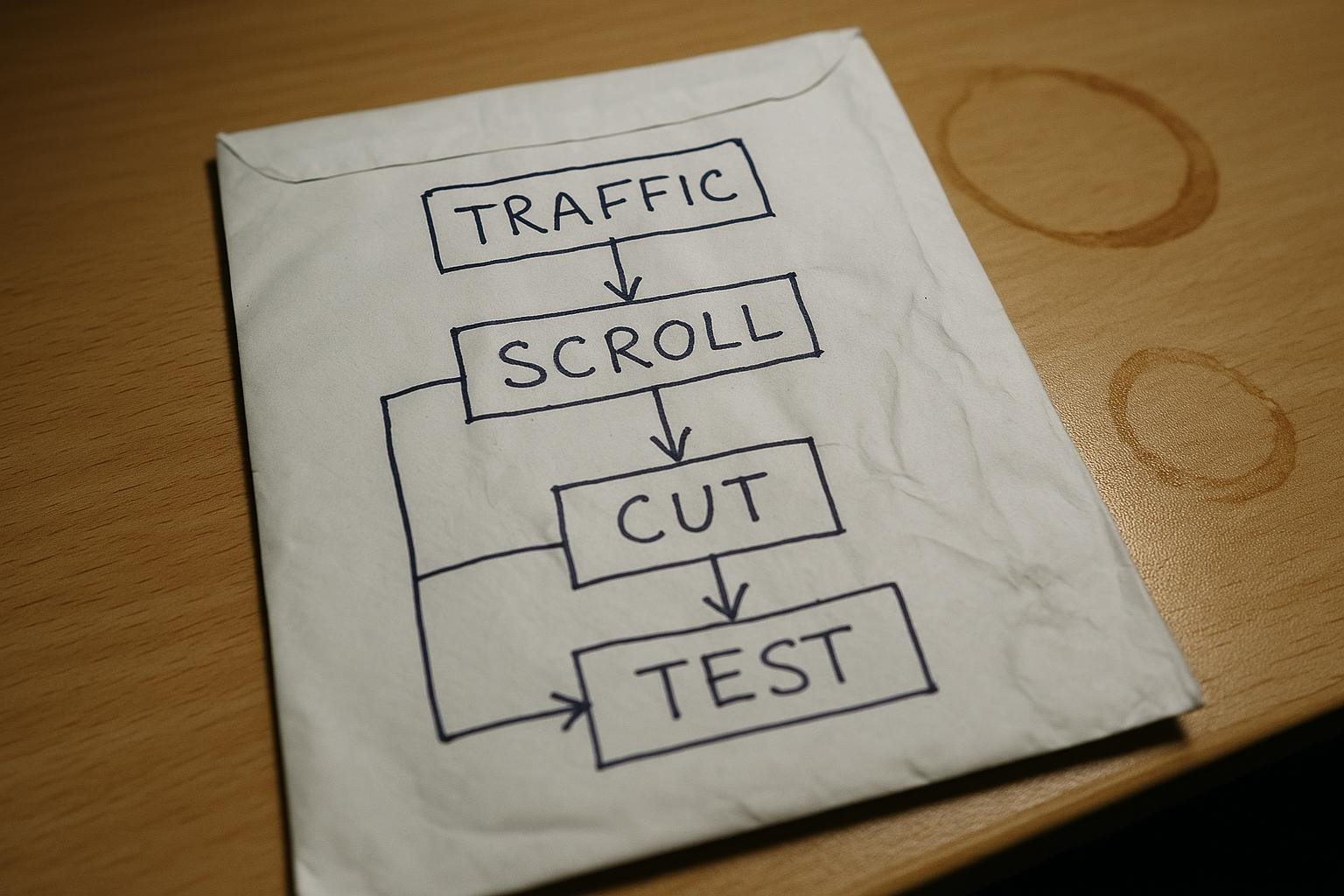
Before you pay for a website redesign, check three numbers: how far visitors scroll, what share of them enquire, and how many clicks Google Search Console says you get from search. If you do not know all three, a redesign is a guess with an invoice attached. Each one takes under twenty minutes to find, and between them they tell you whether the problem is being found, being read, or being believed. Only one of those is fixed by a new design.
What a redesign is, and what it is not
A website redesign is a rebuild of how the site looks and is laid out, usually with new copy and new photos, on the assumption that the current one is holding the business back. That assumption is the problem. "The site looks dated" is a feeling, and a feeling is a bad brief. Sites that look dated and bring in work every week exist. Sites that look beautiful and bring in nothing exist in far greater numbers.
The three numbers turn the feeling into a diagnosis. Each one points at a different fault:
- Search Console clicks tell you whether people are finding the site at all. A redesign does nothing for a site nobody arrives at.
- Scroll depth tells you whether people who arrive read it. If most leave before the halfway point, the top of the page is failing.
- Enquiry rate tells you whether people who read it believe it enough to call, fill in a form or message. If they read to the bottom and do nothing, the offer or the ask is wrong, not the layout.
The problem in your money: a worked example
This is an example; put your own figures in. Say a plumbing firm's site gets 600 visits a month from Google and produces three enquiries. That is an enquiry rate of 0.5 per cent. A plumber's call-out sits between £80 and £150, so use £120. Say half of enquiries become jobs.
For comparison, one real figure: the first month of the new site for Walk On The Wild Side, a pet shop in Tunbridge Wells, brought 1,500 visits and 39 enquiries, which is 2.6 per cent, with 75 per cent of those visits coming from Google. That is not a promise for a plumber. It is evidence that a small local site can run at several times 0.5 per cent.
If the plumbing site moved from 0.5 per cent to 1.5 per cent on the same 600 visits, that is six extra enquiries a month:
6 extra enquiries x 0.5 won x £120 call-out x 12 months = £4,320 a year
Now the point. Whether the site can get from 0.5 to 1.5 per cent depends on why it is at 0.5. If visitors leave at the top, the headline and the first screen need work, which is a small design job. If they read to the bottom and do not call, the number and the button need to be impossible to miss, which is a copy job. If only 600 people a month arrive and that is falling, the fix is pages that rank, not a new look for the pages that do not. Three different faults, three different bills. The redesign quote that arrives before the diagnosis is pricing all three at once and fixing possibly none.
What the data says in 2026
People search for redesigns a lot and for what a redesign costs almost never. UK search volumes from Google Ads data, checked on 13 October 2026:
| Search | Searches a month (UK) |
|---|---|
| website redesign near me | 2,900 (12-month average) |
| ai website redesign | 590 (12-month average) |
| website redesign | 425 (2026 run-rate) |
| website redesign agency | 99 (2026 run-rate) |
| website redesign cost | 48 (2026 run-rate) |
What that means in plain terms: for every person asking what a redesign should cost, sixty are looking for someone nearby to do one. The question "do I need this at all" is barely asked. That is the gap this article fills, and it is why the three numbers come before any quote. The "ai website redesign" figure is worth a note too: 590 a month are hoping a tool will do it. A tool can restyle a page in minutes. It cannot tell you whether the page was the problem.
The three numbers, and what each one means
Number 1: Search Console clicks
What it means: Google Search Console is Google's free report of how often your site appeared in search and how often someone clicked. How you know: open it, choose Performance, then Search results, set the date range to the last six months, and look at the clicks line. Why it matters: if clicks are falling or were never there, your site has a findability problem. A redesign that keeps the same pages and the same words changes nothing Google cares about. If clicks are steady or rising, being found is not the fault, and you can rule it out.
Number 2: scroll depth
What it means: how far down the page visitors get before they leave. How you know: Google Analytics 4 records a "scroll" event by default when a visitor reaches 90 per cent of a page. Compare scroll events with page views for the homepage. If a quarter of visitors reach the bottom, three quarters left before it. A free heatmap tool shows exactly where. Why it matters: if most visitors leave in the first screen, the headline, the first image and the first promise are failing, and that is the one case where a design change is clearly the fix. Check scroll depth before a homepage redesign walks through reading the drop-off point.
Number 3: enquiry rate
What it means: enquiries divided by visits, as a percentage. How you know: count every call, form, WhatsApp and email that came from the site in a month (ask "how did you find us" and write the answer down), and divide by the month's visits from GA4. Why it matters: it is the only number that is money. A site with good clicks and good scroll depth but a low enquiry rate is read and not believed, which means the offer, the proof and the call to action need rewriting. That is cheaper than a rebuild and it is the fix most sites actually need.
The three options, honestly
Option 1: fix the existing site
What it means: keep the design, change the parts the numbers blame. A new headline and first screen if scroll depth is poor. A phone number and button visible on every page if enquiry rate is poor. New pages for the towns and services you want to be found for if clicks are poor. How you know it works: the same three numbers, measured again a month later. Where it falls down: a site on a platform you cannot edit, or so old it does not work on a phone, resists this; and a site with all three numbers bad at once may need more than patching. Who it is right for: most small business sites. New website or fix the existing one sets out the decision in more detail.
Option 2: a full redesign
What it means: new design, new structure, new copy, usually new photos, on the same domain. How you know it is warranted: scroll depth is poor on every page, the site fails on a phone, or you cannot edit it without a developer. Where it falls down: it is the most expensive option and it often launches with the same words, the same missing town pages and the same hidden phone number, because the brief was "make it look modern" rather than "move these three numbers". A redesign that ignores the numbers can send clicks down, because Google re-reads a changed site and does not always like what it finds. Who it is right for: a business whose site genuinely fails on all three counts, or cannot be edited at all, with a brief written from the numbers.
Option 3: replace the site with one landing page plus a Google Business Profile
What it means: retire the ten-page site and run one page with one offer, one message and one action, backed by a complete Google Business Profile, the free listing in Google Maps. How you know it fits: Search Console shows only the homepage ever gets clicks, and the enquiries you get come from Maps anyway. Where it falls down: you give up ranking for anything beyond your business name and your immediate area; a business serving five towns or ten services loses the pages that could win those searches. Who it is right for: a single-location business with one main service, whose customers find it in Maps. For that business it is cheaper than either option above and loses nothing.
The recommendation
Bottom line: find the three numbers first, then fix the one page the numbers blame; pay for a full redesign only when scroll depth is poor on every page or the site cannot be edited, and consider the landing-page route if Search Console shows the homepage is the only page anyone ever finds.
The reason is cost against result. In the example, the £4,320 a year was available from moving the enquiry rate one point, and the fix for that is usually a headline, a button and some proof, not a rebuild. A full redesign costs the most, takes the longest and carries the only real risk in the list, a drop in clicks. It earns its price when the site is failing on every count. It is a poor buy when one page needs one change. What we build starts with the three numbers for exactly this reason: a site is measured, or it is a brochure.
How to do it this week
- Search Console, 5 minutes. Go to search.google.com/search-console. If your site is not listed, add it (the "Domain" option, verified through your domain provider; your web host can do this if you ask). Open Performance, then Search results. Set the date range to "Last 6 months". Note total clicks and whether the line is rising, flat or falling. Click the "Pages" tab below the chart and note which pages get the clicks. Done looks like: a clicks figure and a list of the three pages that earn them.
- Scroll depth, 5 minutes. Open Google Analytics 4. Go to Reports, then Engagement, then Events. Find "scroll" and note the count for the last 30 days. Then go to Reports, Engagement, Pages and screens and note views for the homepage. Divide scroll by views. Done looks like: a percentage. Under 30 per cent means most visitors never reach the bottom.
- Enquiry rate, 10 minutes plus a month. Count last month's enquiries that came through the site: form submissions from your inbox, calls where the caller said "I found you online", WhatsApp messages from the site button. Divide by last month's visits in GA4 (Reports, Acquisition, Traffic acquisition). Done looks like: a percentage. From this week on, ask every enquirer how they found you and write it down.
- Write the diagnosis in one line. "Clicks falling, scroll fine, enquiries fine" means build pages that rank. "Clicks fine, scroll poor" means fix the first screen. "Clicks fine, scroll fine, enquiries poor" means rewrite the offer and make the phone number impossible to miss.
- Make the one-page fix if it is in your gift. Phone number in the header on every page, visible on a mobile. One button that says what happens next. One real review near it. Most site editors let you do this in an hour.
- Only then get quotes. Send the one-line diagnosis and the three numbers to anyone quoting. Ask which number the work will move. Done looks like: a quote that names the number, or no quote.
Mistakes we see
- Redesigning because a competitor did. Their numbers are not your numbers. You do not know whether their new site works either.
- Launching without Search Console. If it was never set up, you have no "before", and no way to notice when the new site loses the clicks the old one had.
- Changing every page URL in the redesign. Google loses the pages it knew. Clicks fall, and the new design gets the blame for a plumbing fault.
- Measuring visits instead of enquiries. Visits are vanity. Enquiries are the number that pays the invoice.
- Hiding the phone number to look clean. Minimal design is fashionable. A tradesperson's customer wants the number in the top corner, on every page, on a phone.
The decision
If you have access to Search Console and Google Analytics, I can read the three numbers for you and come back with the one-line diagnosis and which page it blames, before any quote is written. Want me to do that? If you have neither set up, say so, and the first step is getting them in, which costs nothing and takes an afternoon.