You ask a happy client to say a few words on camera. They say “yeah, absolutely.” You hit record. Two minutes later you have a lovely story about how nice everyone was and precisely zero reason for a prospect to buy. That’s not the client’s fault. Thats your fault for giving them nothing to work with.
The actual problem
Most small-business testimonials fail at the brief. “Just say what you thought of working with us” is not a brief. It’s an invitation to ramble. The client is nervous, they want to be helpful, and with no structure they default to pleasantries. Pleasantries dont sell.
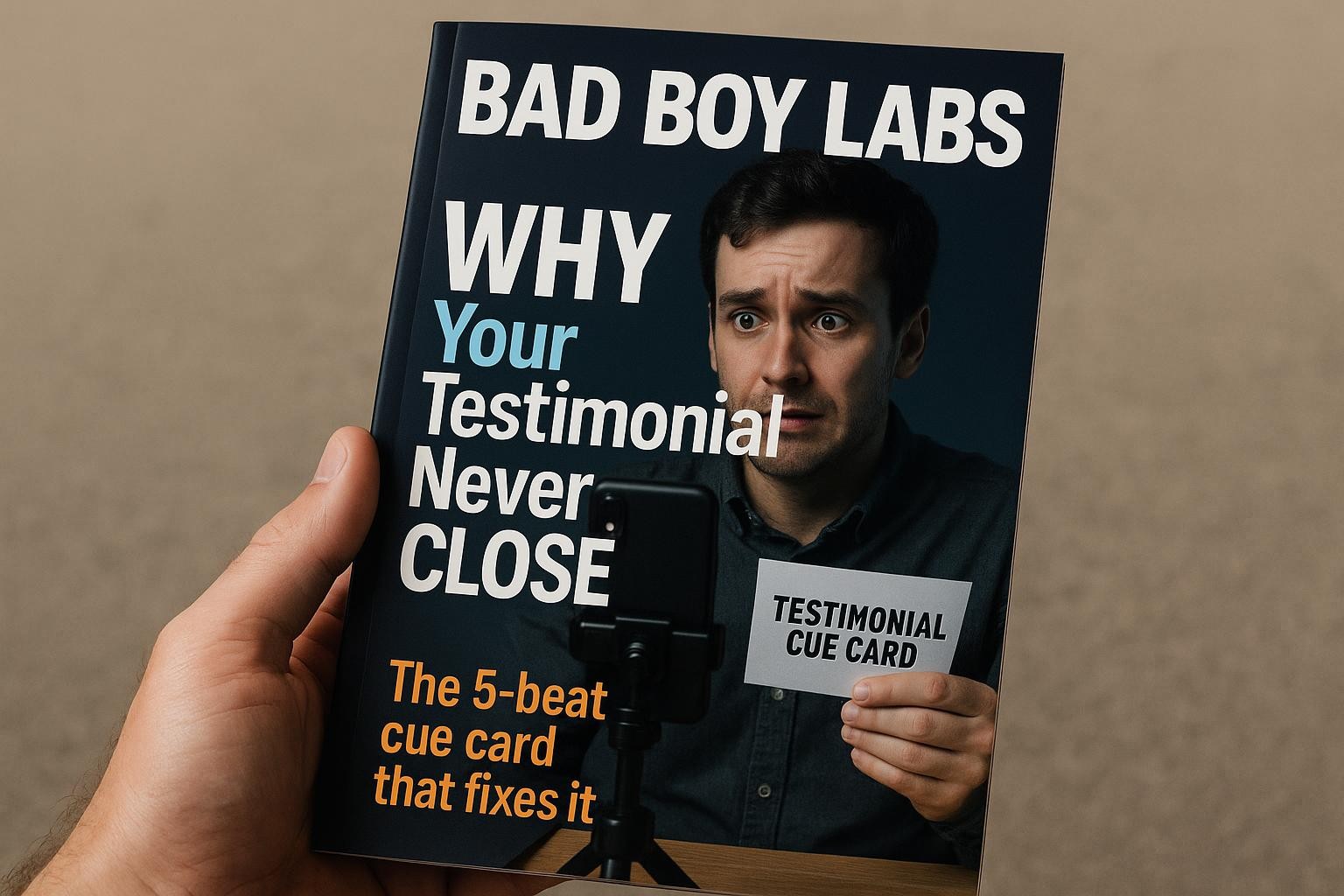
The fix is a cue card. One A4 sheet, big type, five beats, held behind the phone by the person filming. The client’s eyeline stays on the lens. The structure stays in frame. You get a 60-second clip that works.
The 5-beat structure
Print this at 28pt or bigger. The client should be able to read it from a metre away without squinting.
- Beat 1 - Who you are. One sentence. Name, role, what the business does. “I’m Sarah, I run a specialist reptile shop in Ashford.”
- Beat 2 - The problem before. What was broken, slow, or missing before you came along. Keep it specific. “We had no website and all our enquiries came through Facebook.”
- Beat 3 - THE DIFFERENTIATOR. This is the beat that sells. See below.
- Beat 4 - The result. A number if they have one, a feeling if they don’t. Something a prospect can picture. “In the first month we had over a thousand visits from Google and the phone started ringing.”
- Beat 5 - The recommendation. One sentence, direct. “If you’re a local business without a proper web presence, talk to them.”
Beat 3 is the only beat that closes
Beats 1, 2, 4, and 5 are scaffolding. Prospects expect them. They scan past them. Beat 3 is the only beat where a prospect thinks: that’s the thing I haven’t been able to find anywhere else.
On the printed cue card, Beat 3 gets a box around it, a different colour, or both. Make it visually impossible to skip. The client’s job is to answer one question for that beat:
“What did they do that you couldn’t have got from anyone else?”
That’s it. One question. If the client answers it honestly, you have a testimonial that sells.
Add a direction line at the top of the card: Say it like you’d say it to a mate. Not a manager, not a reviewer - a mate. It changes the register immediately.
The cue card in practice
When we ran a testimonial shoot for a BBL client, we made two PDFs. One for the client, one for the person filming.
The client card: five beats in large type, Beat 3 highlighted, rough timings alongside each beat (around 10 seconds each, 15 for Beat 3), and that “say it to a mate” direction at the top. Printed, not sent as a phone screenshot - you want it held behind the camera, not glanced at on a second screen.
The filming card: setup notes, a short shot list, and one piece of B-roll flagged as non-negotiable. More on that below.
The minimum shot list
You need two things. Everything else is a bonus.
- Talking head. Client, eye level, decent light on their face. Shoot landscape. One continuous take is fine - you can trim it. Don’t cut between angles unless you have a second camera, because jump cuts on a single-camera setup look cheap.
- One B-roll clip of the work in use. This is the non-negotiable. If you built a website, film the client at their laptop with the site open. If you built a quoting tool, film them running a quote. Ten seconds of real usage is worth more than thirty seconds of talking head. It makes the result concrete. Mark it on the filming card as “HERO B-ROLL - do not skip.”
Phone cameras are fine. A £15 ring light and a quiet room are fine. A shaky handheld clip with wind noise is not fine - it signals that neither you nor the client took this seriously.
What to do with the footage
Trim the talking head to the five beats. Cut in the B-roll clip over Beat 4 or Beat 3 - wherever the client is describing what changed. Add captions if it’s going anywhere it might play without sound (it will). Keep the whole thing under 90 seconds; 60 is better.
Put it on your website above the fold on the relevant service page. Not buried in a testimonials section nobody scrolls to - above the fold, next to the thing it’s evidence for.
The card template, ready to adapt
BEAT 1 - WHO YOU ARE (10 sec)
Your name, your role, one line about the business.

BEAT 2 - THE PROBLEM BEFORE (10 sec)
What wasn’t working before we started?

*** BEAT 3 - THE DIFFERENTIATOR (15 sec) ***
What did they do that you couldn’t get anywhere else?

BEAT 4 - THE RESULT (10 sec)
What changed? A number if you have one.

BEAT 5 - THE RECOMMENDATION (10 sec)
Who should call them, and why?

---
Say it like you’d say it to a mate.
Print it A4. Hold it behind the phone. Film. You’ll get a better testimonial in one take than most businesses get in a year of asking nicely.
If you want to see how we use this kind of asset on a real site, take a look at our work.