Someone lands on your site. They leave. You buy more ads to send more people to the same page. The leak gets more expensive, not smaller. Before you touch your ad budget, spend an hour with an AI and a honest look at your own pages.
The actual problem
A page converts when three things line up: the visitor understands what you do in under five seconds, they believe you can do it, and they know what to do next. Most small business pages fail on all three. That’s not a traffic problem. Thats a clarity, proof, and CTA problem.
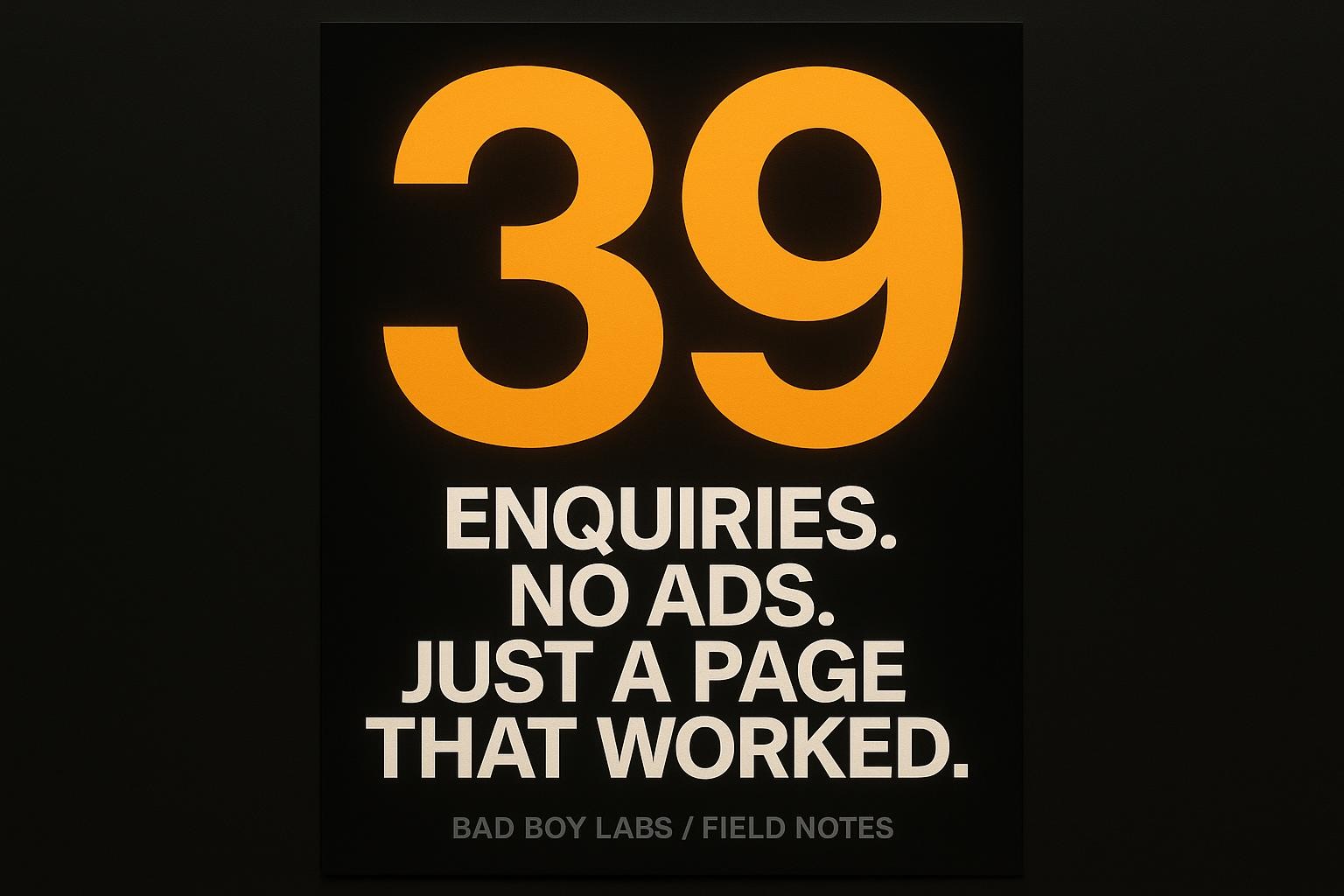
Walk On The Wild Side Reptiles & Aquatics in Ashford had a brand new site. Month one: 1,500 visits from Google, 39 enquiries, roughly 20 sales and 8 reservations. 75% of that traffic came in without a single paid ad. The page worked because it was clear about what was available, who it was for, and what to do. More traffic would have helped. But a leaky page would have wasted most of it.
Step one: paste your page into an AI and ask the hard questions
Open ChatGPT, Claude, or Gemini. Copy the full text of your homepage or your main service page. Paste it in with this prompt:
You are a conversion copywriter. Read this page text and answer:
1. What does this business do, in one plain sentence?
2. Who is it for?
3. What proof is there that it works (testimonials, numbers, specifics)?
4. What is the single next action the visitor should take?
5. List every vague or jargon phrase that a sceptical first-time visitor might not trust.

[PASTE YOUR PAGE TEXT HERE]
Read the answers. If the AI struggles to answer questions one or four in a single sentence, your visitor definitely struggled. That’s your first fix.
Step two: score your proof
Proof is the part most small business sites skip or do badly. “We’re passionate about great service” is not proof. Proof is specific. Run this prompt on your testimonials or about section:
Rate each of these testimonials from 1 to 5 for specificity.
5 = names a real result, a time frame, or a before/after.
1 = generic praise with no detail.
For any rated 3 or below, rewrite it as a question I could ask my real customer
to get a more useful quote.

[PASTE TESTIMONIALS HERE]
The rewrites become your next customer interview script. Dont ask “would you recommend us?” Ask “what were you worried about before you bought, and what actually happened?”
Step three: test your CTA for friction
Your call to action carries more weight than most people give it. “Contact us” is weak. “Get a free quote” is better. “Tell us what you need and we’ll come back within one working day” tells the visitor exactly what happens next and removes the fear of the unknown. Run this:
Here is my current call to action: [YOUR CTA TEXT]
Here is what happens after someone clicks: [DESCRIBE YOUR FORM OR NEXT STEP]

Rewrite the CTA three ways:
- One that reduces fear of commitment
- One that adds a specific time promise
- One that names who this is best for

Keep each under 12 words.
Pick the one that feels most honest about what you actually deliver. Paste it in. That change alone is worth testing before you write a single ad.
Step four: check the five-second rule yourself
This one you do without AI. Open your page on your phone. Set a five-second timer. Look away. When it rings, write down the one thing you remember. If it’s not the core offer or the main benefit, your headline is doing the wrong job. Take that finding back to the AI:
My current headline is: [YOUR HEADLINE]
My business does: [ONE SENTENCE DESCRIPTION]
My best customer is: [WHO THEY ARE]

Write five alternative headlines. Each must pass this test:
a sceptical stranger reads it in five seconds and knows exactly what we do and for whom.
What to do with the output
You’ll end up with a shortlist of changes. Prioritise them like this:
- Headline rewrite - do it today, takes ten minutes
- CTA copy - do it today
- Add or sharpen one specific testimonial - this week
- Remove jargon phrases the AI flagged - this week
- Structural changes (page layout, new sections) - plan these properly
None of this requires a developer for the first four. If your site is on WordPress, Squarespace, or Wix you can make those edits yourself right now.
When to bring in help
If you run this audit and realise the page structure itself is the problem - the wrong sections, missing trust signals, a checkout or enquiry flow that loses people - that’s a build conversation, not a copy tweak. When we build a site, the conversion thinking goes in from the start, not bolted on at the end. If it comes to that, let’s talk it through. But run the audit first. You might fix 60% of the problem for free this afternoon.